Dec 21, 2025

Galileo vs Promptfoo: Features, Strengths, and More

Jackson Wells

Integrated Marketing

Jackson Wells

Integrated Marketing

Galileo vs Promptfoo: Agent Observability & Evaluation Platform Comparison

Your agents fail mysteriously in production, and you must evaluate platforms that claim to solve observability. Galileo offers proprietary small language models with verified million-user deployments. Promptfoo provides open-source flexibility with comprehensive red teaming. 

Both promise to eliminate debugging nightmares, but their architectures, performance characteristics, and production readiness differ dramatically. 

This analysis examines verified capabilities, documented performance benchmarks, and deployment constraints to inform platform selection for your agent systems.

Galileo vs. Promptfoo at a Glance

Both platforms address LLM evaluation and observability, but with fundamentally different approaches. 

Galileo functions as an enterprise observability platform with proprietary evaluation models demonstrating 97% cost reduction versus GPT-4. 

Promptfoo operates as an open-source MIT-licensed testing framework with comprehensive security testing capabilities.

Capability

Galileo

Promptfoo

Architecture

Proprietary SaaS with Luna small language models 

Open-source core (MIT License) with Enterprise tier

Production Scale

10,000 req/min serving 7.7M users

Self-hosting experimental, not recommended for production; Enterprise required for production scale

Latency

Sub-200ms real-time monitoring

~5.4 seconds per test (self-hosted)

Compliance

SOC 2 Type 1/Type 2, GDPR/CCPA

SOC 2 Type II, ISO 27001, HIPAA (claimed)

Pricing

Free (5K traces) → $100/month (50K traces) → Custom

Free (MIT License) → Custom Enterprise

Primary Focus

Production observability and monitoring

Development testing and red teaming

Deployment

Cloud, air-gapped, on-premises

Local-first with Enterprise cloud option

Core Functionality

Production agents execute complex workflows, but standard monitoring shows you symptoms without diagnosis. Errors appear in logs, but isolating which step introduced the failure or identifying similar patterns across other requests remains manual guesswork.

Galileo

Galileo's Graph Engine maps agent execution as interactive visualizations. Every prompt, model call, and tool invocation appears as connected workflow elements you examine instantly rather than reconstructing from log files.

The Insights Engine runs continuous pattern analysis across your complete trace population. It automatically identifies hallucinations, retrieval failures, and incorrect tool selections while performing diagnostic analysis and proposing corrections. 

You're not triggering investigations manually or examining traces individually—the system monitors everything, recognizes deviations, diagnoses causes, and surfaces fixes autonomously. It operates like dedicated engineering resources running 24/7 production surveillance.

Built-in metrics for workflow compliance and tool performance activate immediately. Custom measurements integrate without code deployment. Organizations report 20% faster debugging, compressing eight-hour weekly investigation work into hours.

Agent Protect adds enforcement. When issues exceed severity thresholds, this inline firewall stops harmful outputs or modifies content before reaching end users. 

A Fortune 50 telecommunications operator processing 20 million daily traces uses Agent Protect to eliminate prompt injection attacks and PII exposure before either reaches production systems.

Promptfoo

How do you validate prompt variations across multiple LLM providers without manual bottlenecks? Testing frameworks that process hundreds of provider-prompt combinations enable systematic validation. 

Promptfoo's modular architecture addresses this through five core capabilities: red teaming for adversarial testing, systematic evaluations for prompt and model testing, guardrails for real-time attack protection, model security for file-level screening, and MCP proxy for secure communications.

The evaluation workflow transforms ad-hoc testing into systematic validation through five stages: 

  • Define test cases through inline YAML/JSON or external files

  • Configure evaluations with provider specifications

  • Run evaluations via CLI/library/CI-CD integration

  • Analyze results through comparative dashboards

  • Implement feedback loops for iterative refinement. 

Validation happens at two levels: deterministic checks for exact matching, regex patterns, and JSON format verification, plus model-graded evaluation through LLM-as-judge methodologies. 

Detection spans 50+ vulnerability types including jailbreaks, prompt injections, harmful content generation, PII leakage, and adversarial attacks. Dynamic attack probes adapt to application responses, providing behavioral testing beyond static rule checking. 

Gateway integrations expand model access dramatically. LiteLLM integration provides 400+ LLM access, while TrueFoundry extends coverage to 1000+ models.

Technical Capabilities

Foundation models deliver thorough analysis but introduce multi-second latency that destroys real-time protection capabilities. Cost structures force brutal tradeoffs—either sample a small fraction of traffic to control spending, or evaluate everything and watch infrastructure budgets explode.

Production environments demand both coverage and speed simultaneously.

Galileo

Luna-2 resolves this constraint through specialized small language models optimized specifically for evaluation workloads. 

These purpose-built models process scoring requests an order of magnitude faster than standard large language models, returning results in under 200 milliseconds compared to the 2,600-millisecond average that GPT-4-based evaluation typically requires.

Economic efficiency mirrors the performance advantage. Luna-2 operates at $0.02 per million tokens while GPT-4-based approaches cost $0.15 per million tokens, creating a 97% cost reduction in evaluation infrastructure.

Consider the financial impact at production scale. An enterprise system processing 20 million agent traces daily spends $200,000 monthly on foundation model evaluation—$2.4 million annually just for scoring outputs. 

Luna-2 delivers equivalent detection accuracy for $6,000 monthly, redirecting $2.3 million annually from infrastructure expenses toward product development.

This economic transformation enables operational changes previously impossible. When evaluation costs drop 97%, comprehensive traffic analysis replaces statistical sampling. Instead of examining 10% of requests and extrapolating risk, you assess every interaction. 

Edge cases that would slip through sparse coverage get identified before they propagate.

A Fortune 50 telecommunications operator validated this at a massive scale. They reduced annual evaluation infrastructure spending from $27 million to under $1 million by replacing foundation model calls with Luna-2's specialized approach while simultaneously expanding monitoring coverage.

Continuous Learning via Human Feedback keeps detection aligned with evolving requirements. The system automatically incorporates expert corrections into model behavior, improving accuracy as your domain shifts without manual retraining workflows.

The multi-headed architecture executes hundreds of distinct metrics—toxicity detection, adherence validation, tool selection assessment—across shared computational infrastructure. You're not provisioning separate resources for each new metric. 

Coverage expands without proportional infrastructure growth.

This efficiency creates a unified evaluation lifecycle. Development experiments transition directly into production monitoring without rebuilding pipelines. Those monitoring checks then evolve into runtime enforcement that evaluates and blocks problematic content in under 150 milliseconds within live applications. 

Today's offline tests become tomorrow's inline safeguards through consistent infrastructure.

Real-time guardrails become economically viable at production scale. Speed and cost constraints that previously forced reactive analysis now support proactive intervention before users encounter failures.

Promptfoo

Manual prompt testing across dozens of providers creates validation gaps. Edge cases slip through. Production failures expose what spot-checking missed. 

The YAML-based configuration system establishes repeatable testing workflows through declarative test definitions supporting template-based prompts with variable substitution, multi-provider specifications, and hybrid assertion rules combining deterministic and AI-powered validation.

Five architectural components enable customization: extensible plugins for custom functionality, configurable strategies for testing approaches, specific targets for LLM endpoints, automated test generation engines, and evaluation engines for results processing. 

You adapt the framework to your specific testing requirements rather than conforming to rigid evaluation patterns. Test cases support inline YAML/JSON, external files, CSV, TypeScript/JavaScript generation, and Google Sheets—enabling data scientists, engineers, and QA teams to work in their preferred formats. 

Performance metrics track cost through token usage calculations, latency via response time measurements, and quality through pass/fail rates. 

BLEU scores measure translation tasks, ROUGE metrics evaluate summarization, and Levenshtein distance calculates string similarity.

Integration and Scalability

Production agents generate telemetry across multiple frameworks while your observability remains disconnected. Teams burn weeks building custom collectors, mapping schemas, and testing instrumentation.

Galileo

Galileo's SDK deploys in a single line. Automatic framework detection identifies LangChain, LlamaIndex, or direct OpenAI API calls, streaming metrics immediately without configuration files or manual span definitions. 

You're operational in minutes rather than consuming sprint capacity on telemetry infrastructure.

The serverless backend handles elastic scaling automatically. Whether processing thousands of development traces or millions daily in production, capacity adjusts without provisioning decisions or infrastructure planning. You never size clusters or predict load patterns.

Deployment architecture adapts without code modification. Choose fully managed SaaS for rapid deployment, private VPC when regulated workloads require network isolation, or on-premise infrastructure when data sovereignty mandates prohibit external transmission.

Identical APIs across every deployment model mean your development team builds against SaaS environments while compliance stakeholders mandate on-premise production deployment—instrumentation code remains unchanged. 

This consistency matters when managing multiple environments simultaneously or operating under strict data residency requirements.

Marketplace availability eliminates procurement delays. Auto-scaling prevents capacity over-provisioning. Pay-as-you-go billing ties spending directly to usage volume.

When unexpected events multiply traffic tenfold overnight, observability costs increase linearly with volume rather than exponentially. Budget predictability survives dramatic usage pattern changes.

Promptfoo

Your testing pipeline needs systematic validation without production-scale infrastructure. Promptfoo's architecture optimizes for testing depth rather than throughput volume. 

The self-hosted version explicitly states it is "currently experimental and not recommended for production use" and has no horizontal scaling due to local SQLite database architecture—a critical constraint for teams considering production deployments.

Documented benchmark performance shows approximately 11 tests per minute (0.18 tests per second) in standardized testing scenarios with 5.4 seconds average per test for end-to-end processing. 

Development workflows benefit from this evaluation depth where you're validating prompt iterations or running regression test suites. CI/CD integration enables automated testing through native support for GitHub Actions, GitLab CI, Azure Pipelines, Travis CI, Jenkins, and Looper. 

Automated testing runs during pull request reviews, nightly regression testing, and pre-deployment validation without manual intervention. Deployment options include Docker, Docker Compose, and Kubernetes with Helm. 

Compliance and Security

Regulatory frameworks demand provable safeguards. Auditors need evidence that sensitive data never entered logs, models never processed protected information, and violations were structurally impossible rather than unlikely. 

Detection after exposure doesn't satisfy these mandates.

Galileo

Galileo establishes compliance through required certifications: SOC 2, ISO 27001, and GDPR adherence. These standards provide the audit documentation that legal and compliance teams need during regulatory reviews.

Encryption uses AES 256 for stored data and TLS 1.2 or higher for transmission, preventing unauthorized access across the data lifecycle.

Deterministic PII redaction handles sensitive information through real-time identification and removal. This operates inline as data flows through the system, executing before information reaches models or enters logs. 

Banking and healthcare organizations specifically require this blocking capability rather than detection that flags violations after occurrence.

When prompts accidentally include patient identifiers or financial account numbers, runtime protection removes that information in under 200 milliseconds before it reaches underlying models or gets written to storage. 

Compliance teams demonstrate to auditors that protected data never entered systems subject to regulatory oversight.

Sovereign-ready deployment options support data residency mandates, allowing processing and storage within specific jurisdictions. The observability infrastructure deploys into the same AWS regions, Azure tenants, or private data centers where production workloads run, ensuring data never crosses prohibited boundaries.

Six forward-deployed engineers provide direct support for organizations with complex regulatory requirements, offering hands-on assistance for audit preparation, security assessments, and custom deployment configurations.

Promptfoo

Data sovereignty concerns drive architectural decisions for regulated industries. Promptfoo's local-first execution model processes data on customer infrastructure by default, eliminating external data transfer during evaluation workflows. 

The privacy architecture collects no PII by design, with cloud sharing operating as opt-in functionality. Retention periods for cloud-shared data are limited to 2 weeks.

Promptfoo states SOC 2 Type II, ISO 27001, and HIPAA compliance in public documentation. During vendor evaluation, request formal attestation reports rather than relying on claimed certifications. 

Authentication spans SAML 2.0 and OIDC protocols for SSO integration. Service accounts with scoped API keys enable programmatic access, while granular RBAC supports custom role creation, hierarchical team structures, and fine-grained permission scoping. 

Security testing capabilities integrate adversarial red teaming, guardrails testing, and LLM vulnerability assessment with compliance mapping to OWASP LLM Top 10, NIST AI RMF, and EU AI Act. 

Automated remediation reports surface security findings through centralized management systems with findings management workflows.

Usability and Cost

Most observability platforms promise comprehensive insights but demand weeks configuring dashboards, require data scientists to write custom evaluation logic, and deliver surprise monthly bills. 

By the time you're operational, momentum has stalled and budget conversations have turned contentious.

Galileo

Galileo eliminates setup complexity through no-code metric construction. Direct agent traffic to the SDK and metric builders let you define guardrails or custom KPIs without writing evaluation code. Non-engineers establish quality thresholds and alerting rules through configuration rather than development cycles.

A free tier covering 5,000 traces validates platform fit with actual production data before procurement begins. You're testing against real request patterns within your first day, not evaluating through vendor demos with synthetic datasets.

Luna-2 evaluates at $0.02 per million tokens—97% below GPT-4 pricing. This cost advantage multiplies at scale. At enterprise volumes, comprehensive evaluation across all traffic becomes economically viable instead of sampling strategies that miss edge cases.

A centralized experiment hub consolidates cross-functional collaboration. Product managers compare prompt variations, domain experts add annotations, and engineers trigger alerts within unified workspace. This accessibility matters when expanding from two initial applications to twenty across business units. 

Finance teams validate agent behavior for expense processing without requiring engineering resources to translate technical metrics.

The auto-scaling backend removes infrastructure management entirely. Payment ties to traces processed rather than infrastructure capacity. 

When weekend traffic drops 70% or unexpected launches triple request volume, spending adjusts proportionally and automatically, delivering lower total ownership costs through automation rather than additional headcount.

Customers report measurable gains: manual review compressing from one week to two days, evaluation cycles reduced 75%, and validation workflows accelerating 60%.

Promptfoo

Open-source platforms eliminate license costs but introduce different TCO considerations. Promptfoo's MIT License provides free access to the full evaluation framework, red teaming capabilities, CLI and library access, and self-hosting options. 

This enables unlimited development and testing usage without per-seat or usage-based charges.

The Enterprise tier operates on custom pricing with team sharing, continuous monitoring, priority support, RBAC, SSO, audit logging, and centralized configuration. Organizations requiring production deployment at scale, shared team workflows, or enterprise security features must transition to the Enterprise tier. 

However, the self-hosted open-source version is explicitly not recommended for production use due to architectural limitations (SQLite database constraint preventing horizontal scaling), making the commercial Enterprise version necessary for production deployments. 

Local-first execution consumes existing compute resources rather than vendor-metered cloud services, shifting costs from operational expenses to capital already deployed. 

Official documentation includes executable configuration examples, comprehensive testing scenario guides, and transparent development roadmap visibility through GitHub.

What Customers Say

Galileo

Galileo customers report significant results:

  • "The best thing about this platform is that it helps a lot in the evaluation metrics with precision and I can rely on it, also from the usage I can understand that it is exactly built for the specific needs of the organization and I can say that it's a complete platform for experimentation and can be used for observations as well"

  • "Galileo makes all the effort that is required in assessing and prototyping much easier. Non-snapshots of the model's performance and bias are incredibly useful since they allow for frequent checkups on the model and the application of generative AI in general."

  • "Its best data visualization capabilities and the ability to integrate and analyze diverse datasets on a single platform is very helpful. Also, Its UI with customizations is very simple."

  • Philipp Krenn, Head of DevRel & Developer Advocacy, Elastic: "Galileo's Luna-2 SLMs and evaluation metrics help developers guardrail and understand their LLM-generated data. Combining the capabilities of Galileo and the Elasticsearch vector database empowers developers to build reliable, trustworthy AI systems and agents."

Promptfoo

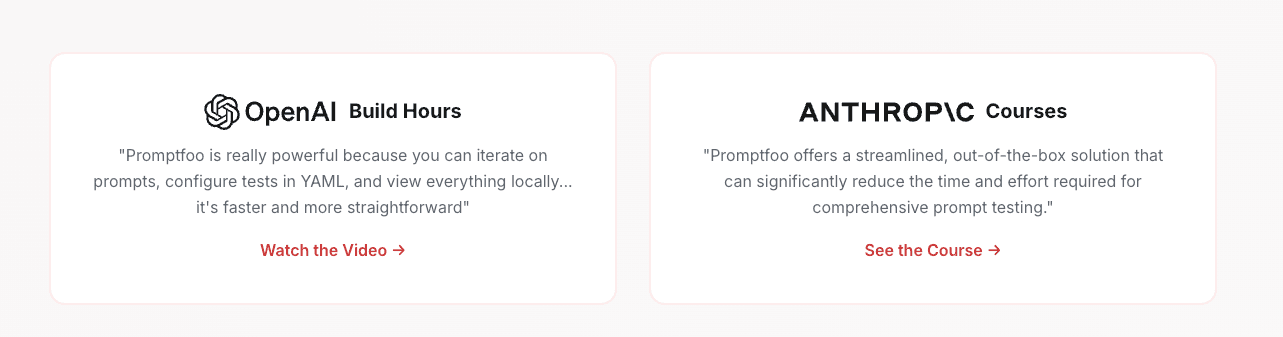
While Promptfoo does not have a G2 profile, it’s website highlights the following reviews:
Which Platform Should You Choose?

Galileo fits organizations deploying agent systems serving millions of users, requiring verified production-scale observability at 10,000 requests per minute. 

Choose Galileo if:

  • You need sub-200ms runtime protection for agents in production

  • You're targeting a 97% evaluation cost reduction with small language model evaluators

  • On-premise or hybrid deployment is non-negotiable for data residency

  • Agent-specific KPIs like tool-choice quality and flow adherence matter more than generic model metrics

  • Prevention beats post-mortem analysis in your reliability playbook

  • You're scaling from 2 applications to 20+ and need cross-functional accessibility

  • Regulated industries require deterministic PII redaction and inline blocking

  • You want debugging time reduced by 20% so teams ship features instead of firefighting

Promptfoo aligns with teams prioritizing open-source MIT licensing to eliminate vendor lock-in concerns and maintain complete platform independence. 

Comprehensive red teaming with 50+ vulnerability types addresses security testing requirements for organizations where adversarial robustness represents a competitive differentiator or regulatory mandate. 

Data sovereignty requirements demanding local-first execution with zero external data transfer fit organizations in heavily regulated industries where data residency trumps other concerns. 

Multi-provider comparative testing across 400-1000+ LLMs through gateway integrations enables systematic model selection for teams evaluating numerous providers before production commitment.

Evaluate Your AI Applications and Agents with Galileo

Moving from reactive debugging to proactive quality assurance requires the right platform, one purpose-built for the complexity of modern multi-agent systems.

Here's how Galileo's comprehensive observability platform provides a unified solution:

Automated quality guardrails in CI/CD: Galileo integrates directly into your development workflow, running comprehensive evaluations on every code change and blocking releases that fail quality thresholds.

Multi-dimensional response evaluation: With Galileo's Luna-2 small language models, you can assess every output across dozens of quality dimensions including correctness, toxicity, bias, and adherence at 97% lower cost than traditional LLM-based evaluation approaches.

Real-time runtime protection: Galileo's Agent Protect scans every prompt and response in production, blocking harmful outputs in under 200ms before they reach users while maintaining detailed compliance logs for audit requirements.

Intelligent failure detection: Galileo's Insights Engine automatically clusters similar failures, surfaces root-cause patterns, and recommends fixes, reducing debugging time by 20% while building institutional knowledge.

Human-in-the-loop optimization: Galileo's Continuous Learning via Human Feedback transforms expert reviews into reusable evaluators, accelerating iteration while maintaining quality standards.

Agent-specific evaluation: Eight purpose-built agent evals including Tool Selection Quality, Action Completion, Agent Efficiency, and Flow Adherence catch failures unique to agentic systems that generic monitoring misses.

Explore how Galileo can help you build reliable applications and AI agents that users trust, and transform your testing process from reactive debugging to proactive quality assurance.

Start your free trial with 5,000 traces and see the difference prevention makes.

Your agents fail mysteriously in production, and you must evaluate platforms that claim to solve observability. Galileo offers proprietary small language models with verified million-user deployments. Promptfoo provides open-source flexibility with comprehensive red teaming. 

Both promise to eliminate debugging nightmares, but their architectures, performance characteristics, and production readiness differ dramatically. 

This analysis examines verified capabilities, documented performance benchmarks, and deployment constraints to inform platform selection for your agent systems.

Galileo vs. Promptfoo at a Glance

Both platforms address LLM evaluation and observability, but with fundamentally different approaches. 

Galileo functions as an enterprise observability platform with proprietary evaluation models demonstrating 97% cost reduction versus GPT-4. 

Promptfoo operates as an open-source MIT-licensed testing framework with comprehensive security testing capabilities.

Capability

Galileo

Promptfoo

Architecture

Proprietary SaaS with Luna small language models 

Open-source core (MIT License) with Enterprise tier

Production Scale

10,000 req/min serving 7.7M users

Self-hosting experimental, not recommended for production; Enterprise required for production scale

Latency

Sub-200ms real-time monitoring

~5.4 seconds per test (self-hosted)

Compliance

SOC 2 Type 1/Type 2, GDPR/CCPA

SOC 2 Type II, ISO 27001, HIPAA (claimed)

Pricing

Free (5K traces) → $100/month (50K traces) → Custom

Free (MIT License) → Custom Enterprise

Primary Focus

Production observability and monitoring

Development testing and red teaming

Deployment

Cloud, air-gapped, on-premises

Local-first with Enterprise cloud option

Core Functionality

Production agents execute complex workflows, but standard monitoring shows you symptoms without diagnosis. Errors appear in logs, but isolating which step introduced the failure or identifying similar patterns across other requests remains manual guesswork.

Galileo

Galileo's Graph Engine maps agent execution as interactive visualizations. Every prompt, model call, and tool invocation appears as connected workflow elements you examine instantly rather than reconstructing from log files.

The Insights Engine runs continuous pattern analysis across your complete trace population. It automatically identifies hallucinations, retrieval failures, and incorrect tool selections while performing diagnostic analysis and proposing corrections. 

You're not triggering investigations manually or examining traces individually—the system monitors everything, recognizes deviations, diagnoses causes, and surfaces fixes autonomously. It operates like dedicated engineering resources running 24/7 production surveillance.

Built-in metrics for workflow compliance and tool performance activate immediately. Custom measurements integrate without code deployment. Organizations report 20% faster debugging, compressing eight-hour weekly investigation work into hours.

Agent Protect adds enforcement. When issues exceed severity thresholds, this inline firewall stops harmful outputs or modifies content before reaching end users. 

A Fortune 50 telecommunications operator processing 20 million daily traces uses Agent Protect to eliminate prompt injection attacks and PII exposure before either reaches production systems.

Promptfoo

How do you validate prompt variations across multiple LLM providers without manual bottlenecks? Testing frameworks that process hundreds of provider-prompt combinations enable systematic validation. 

Promptfoo's modular architecture addresses this through five core capabilities: red teaming for adversarial testing, systematic evaluations for prompt and model testing, guardrails for real-time attack protection, model security for file-level screening, and MCP proxy for secure communications.

The evaluation workflow transforms ad-hoc testing into systematic validation through five stages: 

  • Define test cases through inline YAML/JSON or external files

  • Configure evaluations with provider specifications

  • Run evaluations via CLI/library/CI-CD integration

  • Analyze results through comparative dashboards

  • Implement feedback loops for iterative refinement. 

Validation happens at two levels: deterministic checks for exact matching, regex patterns, and JSON format verification, plus model-graded evaluation through LLM-as-judge methodologies. 

Detection spans 50+ vulnerability types including jailbreaks, prompt injections, harmful content generation, PII leakage, and adversarial attacks. Dynamic attack probes adapt to application responses, providing behavioral testing beyond static rule checking. 

Gateway integrations expand model access dramatically. LiteLLM integration provides 400+ LLM access, while TrueFoundry extends coverage to 1000+ models.

Technical Capabilities

Foundation models deliver thorough analysis but introduce multi-second latency that destroys real-time protection capabilities. Cost structures force brutal tradeoffs—either sample a small fraction of traffic to control spending, or evaluate everything and watch infrastructure budgets explode.

Production environments demand both coverage and speed simultaneously.

Galileo

Luna-2 resolves this constraint through specialized small language models optimized specifically for evaluation workloads. 

These purpose-built models process scoring requests an order of magnitude faster than standard large language models, returning results in under 200 milliseconds compared to the 2,600-millisecond average that GPT-4-based evaluation typically requires.

Economic efficiency mirrors the performance advantage. Luna-2 operates at $0.02 per million tokens while GPT-4-based approaches cost $0.15 per million tokens, creating a 97% cost reduction in evaluation infrastructure.

Consider the financial impact at production scale. An enterprise system processing 20 million agent traces daily spends $200,000 monthly on foundation model evaluation—$2.4 million annually just for scoring outputs. 

Luna-2 delivers equivalent detection accuracy for $6,000 monthly, redirecting $2.3 million annually from infrastructure expenses toward product development.

This economic transformation enables operational changes previously impossible. When evaluation costs drop 97%, comprehensive traffic analysis replaces statistical sampling. Instead of examining 10% of requests and extrapolating risk, you assess every interaction. 

Edge cases that would slip through sparse coverage get identified before they propagate.

A Fortune 50 telecommunications operator validated this at a massive scale. They reduced annual evaluation infrastructure spending from $27 million to under $1 million by replacing foundation model calls with Luna-2's specialized approach while simultaneously expanding monitoring coverage.

Continuous Learning via Human Feedback keeps detection aligned with evolving requirements. The system automatically incorporates expert corrections into model behavior, improving accuracy as your domain shifts without manual retraining workflows.

The multi-headed architecture executes hundreds of distinct metrics—toxicity detection, adherence validation, tool selection assessment—across shared computational infrastructure. You're not provisioning separate resources for each new metric. 

Coverage expands without proportional infrastructure growth.

This efficiency creates a unified evaluation lifecycle. Development experiments transition directly into production monitoring without rebuilding pipelines. Those monitoring checks then evolve into runtime enforcement that evaluates and blocks problematic content in under 150 milliseconds within live applications. 

Today's offline tests become tomorrow's inline safeguards through consistent infrastructure.

Real-time guardrails become economically viable at production scale. Speed and cost constraints that previously forced reactive analysis now support proactive intervention before users encounter failures.

Promptfoo

Manual prompt testing across dozens of providers creates validation gaps. Edge cases slip through. Production failures expose what spot-checking missed. 

The YAML-based configuration system establishes repeatable testing workflows through declarative test definitions supporting template-based prompts with variable substitution, multi-provider specifications, and hybrid assertion rules combining deterministic and AI-powered validation.

Five architectural components enable customization: extensible plugins for custom functionality, configurable strategies for testing approaches, specific targets for LLM endpoints, automated test generation engines, and evaluation engines for results processing. 

You adapt the framework to your specific testing requirements rather than conforming to rigid evaluation patterns. Test cases support inline YAML/JSON, external files, CSV, TypeScript/JavaScript generation, and Google Sheets—enabling data scientists, engineers, and QA teams to work in their preferred formats. 

Performance metrics track cost through token usage calculations, latency via response time measurements, and quality through pass/fail rates. 

BLEU scores measure translation tasks, ROUGE metrics evaluate summarization, and Levenshtein distance calculates string similarity.

Integration and Scalability

Production agents generate telemetry across multiple frameworks while your observability remains disconnected. Teams burn weeks building custom collectors, mapping schemas, and testing instrumentation.

Galileo

Galileo's SDK deploys in a single line. Automatic framework detection identifies LangChain, LlamaIndex, or direct OpenAI API calls, streaming metrics immediately without configuration files or manual span definitions. 

You're operational in minutes rather than consuming sprint capacity on telemetry infrastructure.

The serverless backend handles elastic scaling automatically. Whether processing thousands of development traces or millions daily in production, capacity adjusts without provisioning decisions or infrastructure planning. You never size clusters or predict load patterns.

Deployment architecture adapts without code modification. Choose fully managed SaaS for rapid deployment, private VPC when regulated workloads require network isolation, or on-premise infrastructure when data sovereignty mandates prohibit external transmission.

Identical APIs across every deployment model mean your development team builds against SaaS environments while compliance stakeholders mandate on-premise production deployment—instrumentation code remains unchanged. 

This consistency matters when managing multiple environments simultaneously or operating under strict data residency requirements.

Marketplace availability eliminates procurement delays. Auto-scaling prevents capacity over-provisioning. Pay-as-you-go billing ties spending directly to usage volume.

When unexpected events multiply traffic tenfold overnight, observability costs increase linearly with volume rather than exponentially. Budget predictability survives dramatic usage pattern changes.

Promptfoo

Your testing pipeline needs systematic validation without production-scale infrastructure. Promptfoo's architecture optimizes for testing depth rather than throughput volume. 

The self-hosted version explicitly states it is "currently experimental and not recommended for production use" and has no horizontal scaling due to local SQLite database architecture—a critical constraint for teams considering production deployments.

Documented benchmark performance shows approximately 11 tests per minute (0.18 tests per second) in standardized testing scenarios with 5.4 seconds average per test for end-to-end processing. 

Development workflows benefit from this evaluation depth where you're validating prompt iterations or running regression test suites. CI/CD integration enables automated testing through native support for GitHub Actions, GitLab CI, Azure Pipelines, Travis CI, Jenkins, and Looper. 

Automated testing runs during pull request reviews, nightly regression testing, and pre-deployment validation without manual intervention. Deployment options include Docker, Docker Compose, and Kubernetes with Helm. 

Compliance and Security

Regulatory frameworks demand provable safeguards. Auditors need evidence that sensitive data never entered logs, models never processed protected information, and violations were structurally impossible rather than unlikely. 

Detection after exposure doesn't satisfy these mandates.

Galileo

Galileo establishes compliance through required certifications: SOC 2, ISO 27001, and GDPR adherence. These standards provide the audit documentation that legal and compliance teams need during regulatory reviews.

Encryption uses AES 256 for stored data and TLS 1.2 or higher for transmission, preventing unauthorized access across the data lifecycle.

Deterministic PII redaction handles sensitive information through real-time identification and removal. This operates inline as data flows through the system, executing before information reaches models or enters logs. 

Banking and healthcare organizations specifically require this blocking capability rather than detection that flags violations after occurrence.

When prompts accidentally include patient identifiers or financial account numbers, runtime protection removes that information in under 200 milliseconds before it reaches underlying models or gets written to storage. 

Compliance teams demonstrate to auditors that protected data never entered systems subject to regulatory oversight.

Sovereign-ready deployment options support data residency mandates, allowing processing and storage within specific jurisdictions. The observability infrastructure deploys into the same AWS regions, Azure tenants, or private data centers where production workloads run, ensuring data never crosses prohibited boundaries.

Six forward-deployed engineers provide direct support for organizations with complex regulatory requirements, offering hands-on assistance for audit preparation, security assessments, and custom deployment configurations.

Promptfoo

Data sovereignty concerns drive architectural decisions for regulated industries. Promptfoo's local-first execution model processes data on customer infrastructure by default, eliminating external data transfer during evaluation workflows. 

The privacy architecture collects no PII by design, with cloud sharing operating as opt-in functionality. Retention periods for cloud-shared data are limited to 2 weeks.

Promptfoo states SOC 2 Type II, ISO 27001, and HIPAA compliance in public documentation. During vendor evaluation, request formal attestation reports rather than relying on claimed certifications. 

Authentication spans SAML 2.0 and OIDC protocols for SSO integration. Service accounts with scoped API keys enable programmatic access, while granular RBAC supports custom role creation, hierarchical team structures, and fine-grained permission scoping. 

Security testing capabilities integrate adversarial red teaming, guardrails testing, and LLM vulnerability assessment with compliance mapping to OWASP LLM Top 10, NIST AI RMF, and EU AI Act. 

Automated remediation reports surface security findings through centralized management systems with findings management workflows.

Usability and Cost

Most observability platforms promise comprehensive insights but demand weeks configuring dashboards, require data scientists to write custom evaluation logic, and deliver surprise monthly bills. 

By the time you're operational, momentum has stalled and budget conversations have turned contentious.

Galileo

Galileo eliminates setup complexity through no-code metric construction. Direct agent traffic to the SDK and metric builders let you define guardrails or custom KPIs without writing evaluation code. Non-engineers establish quality thresholds and alerting rules through configuration rather than development cycles.

A free tier covering 5,000 traces validates platform fit with actual production data before procurement begins. You're testing against real request patterns within your first day, not evaluating through vendor demos with synthetic datasets.

Luna-2 evaluates at $0.02 per million tokens—97% below GPT-4 pricing. This cost advantage multiplies at scale. At enterprise volumes, comprehensive evaluation across all traffic becomes economically viable instead of sampling strategies that miss edge cases.

A centralized experiment hub consolidates cross-functional collaboration. Product managers compare prompt variations, domain experts add annotations, and engineers trigger alerts within unified workspace. This accessibility matters when expanding from two initial applications to twenty across business units. 

Finance teams validate agent behavior for expense processing without requiring engineering resources to translate technical metrics.

The auto-scaling backend removes infrastructure management entirely. Payment ties to traces processed rather than infrastructure capacity. 

When weekend traffic drops 70% or unexpected launches triple request volume, spending adjusts proportionally and automatically, delivering lower total ownership costs through automation rather than additional headcount.

Customers report measurable gains: manual review compressing from one week to two days, evaluation cycles reduced 75%, and validation workflows accelerating 60%.

Promptfoo

Open-source platforms eliminate license costs but introduce different TCO considerations. Promptfoo's MIT License provides free access to the full evaluation framework, red teaming capabilities, CLI and library access, and self-hosting options. 

This enables unlimited development and testing usage without per-seat or usage-based charges.

The Enterprise tier operates on custom pricing with team sharing, continuous monitoring, priority support, RBAC, SSO, audit logging, and centralized configuration. Organizations requiring production deployment at scale, shared team workflows, or enterprise security features must transition to the Enterprise tier. 

However, the self-hosted open-source version is explicitly not recommended for production use due to architectural limitations (SQLite database constraint preventing horizontal scaling), making the commercial Enterprise version necessary for production deployments. 

Local-first execution consumes existing compute resources rather than vendor-metered cloud services, shifting costs from operational expenses to capital already deployed. 

Official documentation includes executable configuration examples, comprehensive testing scenario guides, and transparent development roadmap visibility through GitHub.

What Customers Say

Galileo

Galileo customers report significant results:

  • "The best thing about this platform is that it helps a lot in the evaluation metrics with precision and I can rely on it, also from the usage I can understand that it is exactly built for the specific needs of the organization and I can say that it's a complete platform for experimentation and can be used for observations as well"

  • "Galileo makes all the effort that is required in assessing and prototyping much easier. Non-snapshots of the model's performance and bias are incredibly useful since they allow for frequent checkups on the model and the application of generative AI in general."

  • "Its best data visualization capabilities and the ability to integrate and analyze diverse datasets on a single platform is very helpful. Also, Its UI with customizations is very simple."

  • Philipp Krenn, Head of DevRel & Developer Advocacy, Elastic: "Galileo's Luna-2 SLMs and evaluation metrics help developers guardrail and understand their LLM-generated data. Combining the capabilities of Galileo and the Elasticsearch vector database empowers developers to build reliable, trustworthy AI systems and agents."

Promptfoo

While Promptfoo does not have a G2 profile, it’s website highlights the following reviews:

Which Platform Should You Choose?

Galileo fits organizations deploying agent systems serving millions of users, requiring verified production-scale observability at 10,000 requests per minute. 

Choose Galileo if:

  • You need sub-200ms runtime protection for agents in production

  • You're targeting a 97% evaluation cost reduction with small language model evaluators

  • On-premise or hybrid deployment is non-negotiable for data residency

  • Agent-specific KPIs like tool-choice quality and flow adherence matter more than generic model metrics

  • Prevention beats post-mortem analysis in your reliability playbook

  • You're scaling from 2 applications to 20+ and need cross-functional accessibility

  • Regulated industries require deterministic PII redaction and inline blocking

  • You want debugging time reduced by 20% so teams ship features instead of firefighting

Promptfoo aligns with teams prioritizing open-source MIT licensing to eliminate vendor lock-in concerns and maintain complete platform independence. 

Comprehensive red teaming with 50+ vulnerability types addresses security testing requirements for organizations where adversarial robustness represents a competitive differentiator or regulatory mandate. 

Data sovereignty requirements demanding local-first execution with zero external data transfer fit organizations in heavily regulated industries where data residency trumps other concerns. 

Multi-provider comparative testing across 400-1000+ LLMs through gateway integrations enables systematic model selection for teams evaluating numerous providers before production commitment.

Evaluate Your AI Applications and Agents with Galileo

Moving from reactive debugging to proactive quality assurance requires the right platform, one purpose-built for the complexity of modern multi-agent systems.

Here's how Galileo's comprehensive observability platform provides a unified solution:

Automated quality guardrails in CI/CD: Galileo integrates directly into your development workflow, running comprehensive evaluations on every code change and blocking releases that fail quality thresholds.

Multi-dimensional response evaluation: With Galileo's Luna-2 small language models, you can assess every output across dozens of quality dimensions including correctness, toxicity, bias, and adherence at 97% lower cost than traditional LLM-based evaluation approaches.

Real-time runtime protection: Galileo's Agent Protect scans every prompt and response in production, blocking harmful outputs in under 200ms before they reach users while maintaining detailed compliance logs for audit requirements.

Intelligent failure detection: Galileo's Insights Engine automatically clusters similar failures, surfaces root-cause patterns, and recommends fixes, reducing debugging time by 20% while building institutional knowledge.

Human-in-the-loop optimization: Galileo's Continuous Learning via Human Feedback transforms expert reviews into reusable evaluators, accelerating iteration while maintaining quality standards.

Agent-specific evaluation: Eight purpose-built agent evals including Tool Selection Quality, Action Completion, Agent Efficiency, and Flow Adherence catch failures unique to agentic systems that generic monitoring misses.

Explore how Galileo can help you build reliable applications and AI agents that users trust, and transform your testing process from reactive debugging to proactive quality assurance.

Start your free trial with 5,000 traces and see the difference prevention makes.

Your agents fail mysteriously in production, and you must evaluate platforms that claim to solve observability. Galileo offers proprietary small language models with verified million-user deployments. Promptfoo provides open-source flexibility with comprehensive red teaming. 

Both promise to eliminate debugging nightmares, but their architectures, performance characteristics, and production readiness differ dramatically. 

This analysis examines verified capabilities, documented performance benchmarks, and deployment constraints to inform platform selection for your agent systems.

Galileo vs. Promptfoo at a Glance

Both platforms address LLM evaluation and observability, but with fundamentally different approaches. 

Galileo functions as an enterprise observability platform with proprietary evaluation models demonstrating 97% cost reduction versus GPT-4. 

Promptfoo operates as an open-source MIT-licensed testing framework with comprehensive security testing capabilities.

Capability

Galileo

Promptfoo

Architecture

Proprietary SaaS with Luna small language models 

Open-source core (MIT License) with Enterprise tier

Production Scale

10,000 req/min serving 7.7M users

Self-hosting experimental, not recommended for production; Enterprise required for production scale

Latency

Sub-200ms real-time monitoring

~5.4 seconds per test (self-hosted)

Compliance

SOC 2 Type 1/Type 2, GDPR/CCPA

SOC 2 Type II, ISO 27001, HIPAA (claimed)

Pricing

Free (5K traces) → $100/month (50K traces) → Custom

Free (MIT License) → Custom Enterprise

Primary Focus

Production observability and monitoring

Development testing and red teaming

Deployment

Cloud, air-gapped, on-premises

Local-first with Enterprise cloud option

Core Functionality

Production agents execute complex workflows, but standard monitoring shows you symptoms without diagnosis. Errors appear in logs, but isolating which step introduced the failure or identifying similar patterns across other requests remains manual guesswork.

Galileo

Galileo's Graph Engine maps agent execution as interactive visualizations. Every prompt, model call, and tool invocation appears as connected workflow elements you examine instantly rather than reconstructing from log files.

The Insights Engine runs continuous pattern analysis across your complete trace population. It automatically identifies hallucinations, retrieval failures, and incorrect tool selections while performing diagnostic analysis and proposing corrections. 

You're not triggering investigations manually or examining traces individually—the system monitors everything, recognizes deviations, diagnoses causes, and surfaces fixes autonomously. It operates like dedicated engineering resources running 24/7 production surveillance.

Built-in metrics for workflow compliance and tool performance activate immediately. Custom measurements integrate without code deployment. Organizations report 20% faster debugging, compressing eight-hour weekly investigation work into hours.

Agent Protect adds enforcement. When issues exceed severity thresholds, this inline firewall stops harmful outputs or modifies content before reaching end users. 

A Fortune 50 telecommunications operator processing 20 million daily traces uses Agent Protect to eliminate prompt injection attacks and PII exposure before either reaches production systems.

Promptfoo

How do you validate prompt variations across multiple LLM providers without manual bottlenecks? Testing frameworks that process hundreds of provider-prompt combinations enable systematic validation. 

Promptfoo's modular architecture addresses this through five core capabilities: red teaming for adversarial testing, systematic evaluations for prompt and model testing, guardrails for real-time attack protection, model security for file-level screening, and MCP proxy for secure communications.

The evaluation workflow transforms ad-hoc testing into systematic validation through five stages: 

  • Define test cases through inline YAML/JSON or external files

  • Configure evaluations with provider specifications

  • Run evaluations via CLI/library/CI-CD integration

  • Analyze results through comparative dashboards

  • Implement feedback loops for iterative refinement. 

Validation happens at two levels: deterministic checks for exact matching, regex patterns, and JSON format verification, plus model-graded evaluation through LLM-as-judge methodologies. 

Detection spans 50+ vulnerability types including jailbreaks, prompt injections, harmful content generation, PII leakage, and adversarial attacks. Dynamic attack probes adapt to application responses, providing behavioral testing beyond static rule checking. 

Gateway integrations expand model access dramatically. LiteLLM integration provides 400+ LLM access, while TrueFoundry extends coverage to 1000+ models.

Technical Capabilities

Foundation models deliver thorough analysis but introduce multi-second latency that destroys real-time protection capabilities. Cost structures force brutal tradeoffs—either sample a small fraction of traffic to control spending, or evaluate everything and watch infrastructure budgets explode.

Production environments demand both coverage and speed simultaneously.

Galileo

Luna-2 resolves this constraint through specialized small language models optimized specifically for evaluation workloads. 

These purpose-built models process scoring requests an order of magnitude faster than standard large language models, returning results in under 200 milliseconds compared to the 2,600-millisecond average that GPT-4-based evaluation typically requires.

Economic efficiency mirrors the performance advantage. Luna-2 operates at $0.02 per million tokens while GPT-4-based approaches cost $0.15 per million tokens, creating a 97% cost reduction in evaluation infrastructure.

Consider the financial impact at production scale. An enterprise system processing 20 million agent traces daily spends $200,000 monthly on foundation model evaluation—$2.4 million annually just for scoring outputs. 

Luna-2 delivers equivalent detection accuracy for $6,000 monthly, redirecting $2.3 million annually from infrastructure expenses toward product development.

This economic transformation enables operational changes previously impossible. When evaluation costs drop 97%, comprehensive traffic analysis replaces statistical sampling. Instead of examining 10% of requests and extrapolating risk, you assess every interaction. 

Edge cases that would slip through sparse coverage get identified before they propagate.

A Fortune 50 telecommunications operator validated this at a massive scale. They reduced annual evaluation infrastructure spending from $27 million to under $1 million by replacing foundation model calls with Luna-2's specialized approach while simultaneously expanding monitoring coverage.

Continuous Learning via Human Feedback keeps detection aligned with evolving requirements. The system automatically incorporates expert corrections into model behavior, improving accuracy as your domain shifts without manual retraining workflows.

The multi-headed architecture executes hundreds of distinct metrics—toxicity detection, adherence validation, tool selection assessment—across shared computational infrastructure. You're not provisioning separate resources for each new metric. 

Coverage expands without proportional infrastructure growth.

This efficiency creates a unified evaluation lifecycle. Development experiments transition directly into production monitoring without rebuilding pipelines. Those monitoring checks then evolve into runtime enforcement that evaluates and blocks problematic content in under 150 milliseconds within live applications. 

Today's offline tests become tomorrow's inline safeguards through consistent infrastructure.

Real-time guardrails become economically viable at production scale. Speed and cost constraints that previously forced reactive analysis now support proactive intervention before users encounter failures.

Promptfoo

Manual prompt testing across dozens of providers creates validation gaps. Edge cases slip through. Production failures expose what spot-checking missed. 

The YAML-based configuration system establishes repeatable testing workflows through declarative test definitions supporting template-based prompts with variable substitution, multi-provider specifications, and hybrid assertion rules combining deterministic and AI-powered validation.

Five architectural components enable customization: extensible plugins for custom functionality, configurable strategies for testing approaches, specific targets for LLM endpoints, automated test generation engines, and evaluation engines for results processing. 

You adapt the framework to your specific testing requirements rather than conforming to rigid evaluation patterns. Test cases support inline YAML/JSON, external files, CSV, TypeScript/JavaScript generation, and Google Sheets—enabling data scientists, engineers, and QA teams to work in their preferred formats. 

Performance metrics track cost through token usage calculations, latency via response time measurements, and quality through pass/fail rates. 

BLEU scores measure translation tasks, ROUGE metrics evaluate summarization, and Levenshtein distance calculates string similarity.

Integration and Scalability

Production agents generate telemetry across multiple frameworks while your observability remains disconnected. Teams burn weeks building custom collectors, mapping schemas, and testing instrumentation.

Galileo

Galileo's SDK deploys in a single line. Automatic framework detection identifies LangChain, LlamaIndex, or direct OpenAI API calls, streaming metrics immediately without configuration files or manual span definitions. 

You're operational in minutes rather than consuming sprint capacity on telemetry infrastructure.

The serverless backend handles elastic scaling automatically. Whether processing thousands of development traces or millions daily in production, capacity adjusts without provisioning decisions or infrastructure planning. You never size clusters or predict load patterns.

Deployment architecture adapts without code modification. Choose fully managed SaaS for rapid deployment, private VPC when regulated workloads require network isolation, or on-premise infrastructure when data sovereignty mandates prohibit external transmission.

Identical APIs across every deployment model mean your development team builds against SaaS environments while compliance stakeholders mandate on-premise production deployment—instrumentation code remains unchanged. 

This consistency matters when managing multiple environments simultaneously or operating under strict data residency requirements.

Marketplace availability eliminates procurement delays. Auto-scaling prevents capacity over-provisioning. Pay-as-you-go billing ties spending directly to usage volume.

When unexpected events multiply traffic tenfold overnight, observability costs increase linearly with volume rather than exponentially. Budget predictability survives dramatic usage pattern changes.

Promptfoo

Your testing pipeline needs systematic validation without production-scale infrastructure. Promptfoo's architecture optimizes for testing depth rather than throughput volume. 

The self-hosted version explicitly states it is "currently experimental and not recommended for production use" and has no horizontal scaling due to local SQLite database architecture—a critical constraint for teams considering production deployments.

Documented benchmark performance shows approximately 11 tests per minute (0.18 tests per second) in standardized testing scenarios with 5.4 seconds average per test for end-to-end processing. 

Development workflows benefit from this evaluation depth where you're validating prompt iterations or running regression test suites. CI/CD integration enables automated testing through native support for GitHub Actions, GitLab CI, Azure Pipelines, Travis CI, Jenkins, and Looper. 

Automated testing runs during pull request reviews, nightly regression testing, and pre-deployment validation without manual intervention. Deployment options include Docker, Docker Compose, and Kubernetes with Helm. 

Compliance and Security

Regulatory frameworks demand provable safeguards. Auditors need evidence that sensitive data never entered logs, models never processed protected information, and violations were structurally impossible rather than unlikely. 

Detection after exposure doesn't satisfy these mandates.

Galileo

Galileo establishes compliance through required certifications: SOC 2, ISO 27001, and GDPR adherence. These standards provide the audit documentation that legal and compliance teams need during regulatory reviews.

Encryption uses AES 256 for stored data and TLS 1.2 or higher for transmission, preventing unauthorized access across the data lifecycle.

Deterministic PII redaction handles sensitive information through real-time identification and removal. This operates inline as data flows through the system, executing before information reaches models or enters logs. 

Banking and healthcare organizations specifically require this blocking capability rather than detection that flags violations after occurrence.

When prompts accidentally include patient identifiers or financial account numbers, runtime protection removes that information in under 200 milliseconds before it reaches underlying models or gets written to storage. 

Compliance teams demonstrate to auditors that protected data never entered systems subject to regulatory oversight.

Sovereign-ready deployment options support data residency mandates, allowing processing and storage within specific jurisdictions. The observability infrastructure deploys into the same AWS regions, Azure tenants, or private data centers where production workloads run, ensuring data never crosses prohibited boundaries.

Six forward-deployed engineers provide direct support for organizations with complex regulatory requirements, offering hands-on assistance for audit preparation, security assessments, and custom deployment configurations.

Promptfoo

Data sovereignty concerns drive architectural decisions for regulated industries. Promptfoo's local-first execution model processes data on customer infrastructure by default, eliminating external data transfer during evaluation workflows. 

The privacy architecture collects no PII by design, with cloud sharing operating as opt-in functionality. Retention periods for cloud-shared data are limited to 2 weeks.

Promptfoo states SOC 2 Type II, ISO 27001, and HIPAA compliance in public documentation. During vendor evaluation, request formal attestation reports rather than relying on claimed certifications. 

Authentication spans SAML 2.0 and OIDC protocols for SSO integration. Service accounts with scoped API keys enable programmatic access, while granular RBAC supports custom role creation, hierarchical team structures, and fine-grained permission scoping. 

Security testing capabilities integrate adversarial red teaming, guardrails testing, and LLM vulnerability assessment with compliance mapping to OWASP LLM Top 10, NIST AI RMF, and EU AI Act. 

Automated remediation reports surface security findings through centralized management systems with findings management workflows.

Usability and Cost

Most observability platforms promise comprehensive insights but demand weeks configuring dashboards, require data scientists to write custom evaluation logic, and deliver surprise monthly bills. 

By the time you're operational, momentum has stalled and budget conversations have turned contentious.

Galileo

Galileo eliminates setup complexity through no-code metric construction. Direct agent traffic to the SDK and metric builders let you define guardrails or custom KPIs without writing evaluation code. Non-engineers establish quality thresholds and alerting rules through configuration rather than development cycles.

A free tier covering 5,000 traces validates platform fit with actual production data before procurement begins. You're testing against real request patterns within your first day, not evaluating through vendor demos with synthetic datasets.

Luna-2 evaluates at $0.02 per million tokens—97% below GPT-4 pricing. This cost advantage multiplies at scale. At enterprise volumes, comprehensive evaluation across all traffic becomes economically viable instead of sampling strategies that miss edge cases.

A centralized experiment hub consolidates cross-functional collaboration. Product managers compare prompt variations, domain experts add annotations, and engineers trigger alerts within unified workspace. This accessibility matters when expanding from two initial applications to twenty across business units. 

Finance teams validate agent behavior for expense processing without requiring engineering resources to translate technical metrics.

The auto-scaling backend removes infrastructure management entirely. Payment ties to traces processed rather than infrastructure capacity. 

When weekend traffic drops 70% or unexpected launches triple request volume, spending adjusts proportionally and automatically, delivering lower total ownership costs through automation rather than additional headcount.

Customers report measurable gains: manual review compressing from one week to two days, evaluation cycles reduced 75%, and validation workflows accelerating 60%.

Promptfoo

Open-source platforms eliminate license costs but introduce different TCO considerations. Promptfoo's MIT License provides free access to the full evaluation framework, red teaming capabilities, CLI and library access, and self-hosting options. 

This enables unlimited development and testing usage without per-seat or usage-based charges.

The Enterprise tier operates on custom pricing with team sharing, continuous monitoring, priority support, RBAC, SSO, audit logging, and centralized configuration. Organizations requiring production deployment at scale, shared team workflows, or enterprise security features must transition to the Enterprise tier. 

However, the self-hosted open-source version is explicitly not recommended for production use due to architectural limitations (SQLite database constraint preventing horizontal scaling), making the commercial Enterprise version necessary for production deployments. 

Local-first execution consumes existing compute resources rather than vendor-metered cloud services, shifting costs from operational expenses to capital already deployed. 

Official documentation includes executable configuration examples, comprehensive testing scenario guides, and transparent development roadmap visibility through GitHub.

What Customers Say

Galileo

Galileo customers report significant results:

  • "The best thing about this platform is that it helps a lot in the evaluation metrics with precision and I can rely on it, also from the usage I can understand that it is exactly built for the specific needs of the organization and I can say that it's a complete platform for experimentation and can be used for observations as well"

  • "Galileo makes all the effort that is required in assessing and prototyping much easier. Non-snapshots of the model's performance and bias are incredibly useful since they allow for frequent checkups on the model and the application of generative AI in general."

  • "Its best data visualization capabilities and the ability to integrate and analyze diverse datasets on a single platform is very helpful. Also, Its UI with customizations is very simple."

  • Philipp Krenn, Head of DevRel & Developer Advocacy, Elastic: "Galileo's Luna-2 SLMs and evaluation metrics help developers guardrail and understand their LLM-generated data. Combining the capabilities of Galileo and the Elasticsearch vector database empowers developers to build reliable, trustworthy AI systems and agents."

Promptfoo

While Promptfoo does not have a G2 profile, it’s website highlights the following reviews:

Which Platform Should You Choose?

Galileo fits organizations deploying agent systems serving millions of users, requiring verified production-scale observability at 10,000 requests per minute. 

Choose Galileo if:

  • You need sub-200ms runtime protection for agents in production

  • You're targeting a 97% evaluation cost reduction with small language model evaluators

  • On-premise or hybrid deployment is non-negotiable for data residency

  • Agent-specific KPIs like tool-choice quality and flow adherence matter more than generic model metrics

  • Prevention beats post-mortem analysis in your reliability playbook

  • You're scaling from 2 applications to 20+ and need cross-functional accessibility

  • Regulated industries require deterministic PII redaction and inline blocking

  • You want debugging time reduced by 20% so teams ship features instead of firefighting

Promptfoo aligns with teams prioritizing open-source MIT licensing to eliminate vendor lock-in concerns and maintain complete platform independence. 

Comprehensive red teaming with 50+ vulnerability types addresses security testing requirements for organizations where adversarial robustness represents a competitive differentiator or regulatory mandate. 

Data sovereignty requirements demanding local-first execution with zero external data transfer fit organizations in heavily regulated industries where data residency trumps other concerns. 

Multi-provider comparative testing across 400-1000+ LLMs through gateway integrations enables systematic model selection for teams evaluating numerous providers before production commitment.

Evaluate Your AI Applications and Agents with Galileo

Moving from reactive debugging to proactive quality assurance requires the right platform, one purpose-built for the complexity of modern multi-agent systems.

Here's how Galileo's comprehensive observability platform provides a unified solution:

Automated quality guardrails in CI/CD: Galileo integrates directly into your development workflow, running comprehensive evaluations on every code change and blocking releases that fail quality thresholds.

Multi-dimensional response evaluation: With Galileo's Luna-2 small language models, you can assess every output across dozens of quality dimensions including correctness, toxicity, bias, and adherence at 97% lower cost than traditional LLM-based evaluation approaches.

Real-time runtime protection: Galileo's Agent Protect scans every prompt and response in production, blocking harmful outputs in under 200ms before they reach users while maintaining detailed compliance logs for audit requirements.

Intelligent failure detection: Galileo's Insights Engine automatically clusters similar failures, surfaces root-cause patterns, and recommends fixes, reducing debugging time by 20% while building institutional knowledge.

Human-in-the-loop optimization: Galileo's Continuous Learning via Human Feedback transforms expert reviews into reusable evaluators, accelerating iteration while maintaining quality standards.

Agent-specific evaluation: Eight purpose-built agent evals including Tool Selection Quality, Action Completion, Agent Efficiency, and Flow Adherence catch failures unique to agentic systems that generic monitoring misses.

Explore how Galileo can help you build reliable applications and AI agents that users trust, and transform your testing process from reactive debugging to proactive quality assurance.

Start your free trial with 5,000 traces and see the difference prevention makes.

Your agents fail mysteriously in production, and you must evaluate platforms that claim to solve observability. Galileo offers proprietary small language models with verified million-user deployments. Promptfoo provides open-source flexibility with comprehensive red teaming. 

Both promise to eliminate debugging nightmares, but their architectures, performance characteristics, and production readiness differ dramatically. 

This analysis examines verified capabilities, documented performance benchmarks, and deployment constraints to inform platform selection for your agent systems.

Galileo vs. Promptfoo at a Glance

Both platforms address LLM evaluation and observability, but with fundamentally different approaches. 

Galileo functions as an enterprise observability platform with proprietary evaluation models demonstrating 97% cost reduction versus GPT-4. 

Promptfoo operates as an open-source MIT-licensed testing framework with comprehensive security testing capabilities.

Capability

Galileo

Promptfoo

Architecture

Proprietary SaaS with Luna small language models 

Open-source core (MIT License) with Enterprise tier

Production Scale

10,000 req/min serving 7.7M users

Self-hosting experimental, not recommended for production; Enterprise required for production scale

Latency

Sub-200ms real-time monitoring

~5.4 seconds per test (self-hosted)

Compliance

SOC 2 Type 1/Type 2, GDPR/CCPA

SOC 2 Type II, ISO 27001, HIPAA (claimed)

Pricing

Free (5K traces) → $100/month (50K traces) → Custom

Free (MIT License) → Custom Enterprise

Primary Focus

Production observability and monitoring

Development testing and red teaming

Deployment

Cloud, air-gapped, on-premises

Local-first with Enterprise cloud option

Core Functionality

Production agents execute complex workflows, but standard monitoring shows you symptoms without diagnosis. Errors appear in logs, but isolating which step introduced the failure or identifying similar patterns across other requests remains manual guesswork.

Galileo

Galileo's Graph Engine maps agent execution as interactive visualizations. Every prompt, model call, and tool invocation appears as connected workflow elements you examine instantly rather than reconstructing from log files.

The Insights Engine runs continuous pattern analysis across your complete trace population. It automatically identifies hallucinations, retrieval failures, and incorrect tool selections while performing diagnostic analysis and proposing corrections. 

You're not triggering investigations manually or examining traces individually—the system monitors everything, recognizes deviations, diagnoses causes, and surfaces fixes autonomously. It operates like dedicated engineering resources running 24/7 production surveillance.

Built-in metrics for workflow compliance and tool performance activate immediately. Custom measurements integrate without code deployment. Organizations report 20% faster debugging, compressing eight-hour weekly investigation work into hours.

Agent Protect adds enforcement. When issues exceed severity thresholds, this inline firewall stops harmful outputs or modifies content before reaching end users. 

A Fortune 50 telecommunications operator processing 20 million daily traces uses Agent Protect to eliminate prompt injection attacks and PII exposure before either reaches production systems.

Promptfoo

How do you validate prompt variations across multiple LLM providers without manual bottlenecks? Testing frameworks that process hundreds of provider-prompt combinations enable systematic validation. 

Promptfoo's modular architecture addresses this through five core capabilities: red teaming for adversarial testing, systematic evaluations for prompt and model testing, guardrails for real-time attack protection, model security for file-level screening, and MCP proxy for secure communications.

The evaluation workflow transforms ad-hoc testing into systematic validation through five stages: 

  • Define test cases through inline YAML/JSON or external files

  • Configure evaluations with provider specifications

  • Run evaluations via CLI/library/CI-CD integration

  • Analyze results through comparative dashboards

  • Implement feedback loops for iterative refinement. 

Validation happens at two levels: deterministic checks for exact matching, regex patterns, and JSON format verification, plus model-graded evaluation through LLM-as-judge methodologies. 

Detection spans 50+ vulnerability types including jailbreaks, prompt injections, harmful content generation, PII leakage, and adversarial attacks. Dynamic attack probes adapt to application responses, providing behavioral testing beyond static rule checking. 

Gateway integrations expand model access dramatically. LiteLLM integration provides 400+ LLM access, while TrueFoundry extends coverage to 1000+ models.

Technical Capabilities

Foundation models deliver thorough analysis but introduce multi-second latency that destroys real-time protection capabilities. Cost structures force brutal tradeoffs—either sample a small fraction of traffic to control spending, or evaluate everything and watch infrastructure budgets explode.

Production environments demand both coverage and speed simultaneously.

Galileo

Luna-2 resolves this constraint through specialized small language models optimized specifically for evaluation workloads. 

These purpose-built models process scoring requests an order of magnitude faster than standard large language models, returning results in under 200 milliseconds compared to the 2,600-millisecond average that GPT-4-based evaluation typically requires.

Economic efficiency mirrors the performance advantage. Luna-2 operates at $0.02 per million tokens while GPT-4-based approaches cost $0.15 per million tokens, creating a 97% cost reduction in evaluation infrastructure.

Consider the financial impact at production scale. An enterprise system processing 20 million agent traces daily spends $200,000 monthly on foundation model evaluation—$2.4 million annually just for scoring outputs. 

Luna-2 delivers equivalent detection accuracy for $6,000 monthly, redirecting $2.3 million annually from infrastructure expenses toward product development.

This economic transformation enables operational changes previously impossible. When evaluation costs drop 97%, comprehensive traffic analysis replaces statistical sampling. Instead of examining 10% of requests and extrapolating risk, you assess every interaction. 

Edge cases that would slip through sparse coverage get identified before they propagate.

A Fortune 50 telecommunications operator validated this at a massive scale. They reduced annual evaluation infrastructure spending from $27 million to under $1 million by replacing foundation model calls with Luna-2's specialized approach while simultaneously expanding monitoring coverage.

Continuous Learning via Human Feedback keeps detection aligned with evolving requirements. The system automatically incorporates expert corrections into model behavior, improving accuracy as your domain shifts without manual retraining workflows.

The multi-headed architecture executes hundreds of distinct metrics—toxicity detection, adherence validation, tool selection assessment—across shared computational infrastructure. You're not provisioning separate resources for each new metric. 

Coverage expands without proportional infrastructure growth.

This efficiency creates a unified evaluation lifecycle. Development experiments transition directly into production monitoring without rebuilding pipelines. Those monitoring checks then evolve into runtime enforcement that evaluates and blocks problematic content in under 150 milliseconds within live applications. 

Today's offline tests become tomorrow's inline safeguards through consistent infrastructure.

Real-time guardrails become economically viable at production scale. Speed and cost constraints that previously forced reactive analysis now support proactive intervention before users encounter failures.

Promptfoo

Manual prompt testing across dozens of providers creates validation gaps. Edge cases slip through. Production failures expose what spot-checking missed. 

The YAML-based configuration system establishes repeatable testing workflows through declarative test definitions supporting template-based prompts with variable substitution, multi-provider specifications, and hybrid assertion rules combining deterministic and AI-powered validation.

Five architectural components enable customization: extensible plugins for custom functionality, configurable strategies for testing approaches, specific targets for LLM endpoints, automated test generation engines, and evaluation engines for results processing. 

You adapt the framework to your specific testing requirements rather than conforming to rigid evaluation patterns. Test cases support inline YAML/JSON, external files, CSV, TypeScript/JavaScript generation, and Google Sheets—enabling data scientists, engineers, and QA teams to work in their preferred formats. 

Performance metrics track cost through token usage calculations, latency via response time measurements, and quality through pass/fail rates. 

BLEU scores measure translation tasks, ROUGE metrics evaluate summarization, and Levenshtein distance calculates string similarity.

Integration and Scalability

Production agents generate telemetry across multiple frameworks while your observability remains disconnected. Teams burn weeks building custom collectors, mapping schemas, and testing instrumentation.

Galileo

Galileo's SDK deploys in a single line. Automatic framework detection identifies LangChain, LlamaIndex, or direct OpenAI API calls, streaming metrics immediately without configuration files or manual span definitions. 

You're operational in minutes rather than consuming sprint capacity on telemetry infrastructure.

The serverless backend handles elastic scaling automatically. Whether processing thousands of development traces or millions daily in production, capacity adjusts without provisioning decisions or infrastructure planning. You never size clusters or predict load patterns.

Deployment architecture adapts without code modification. Choose fully managed SaaS for rapid deployment, private VPC when regulated workloads require network isolation, or on-premise infrastructure when data sovereignty mandates prohibit external transmission.

Identical APIs across every deployment model mean your development team builds against SaaS environments while compliance stakeholders mandate on-premise production deployment—instrumentation code remains unchanged. 

This consistency matters when managing multiple environments simultaneously or operating under strict data residency requirements.

Marketplace availability eliminates procurement delays. Auto-scaling prevents capacity over-provisioning. Pay-as-you-go billing ties spending directly to usage volume.

When unexpected events multiply traffic tenfold overnight, observability costs increase linearly with volume rather than exponentially. Budget predictability survives dramatic usage pattern changes.

Promptfoo

Your testing pipeline needs systematic validation without production-scale infrastructure. Promptfoo's architecture optimizes for testing depth rather than throughput volume. 

The self-hosted version explicitly states it is "currently experimental and not recommended for production use" and has no horizontal scaling due to local SQLite database architecture—a critical constraint for teams considering production deployments.

Documented benchmark performance shows approximately 11 tests per minute (0.18 tests per second) in standardized testing scenarios with 5.4 seconds average per test for end-to-end processing. 

Development workflows benefit from this evaluation depth where you're validating prompt iterations or running regression test suites. CI/CD integration enables automated testing through native support for GitHub Actions, GitLab CI, Azure Pipelines, Travis CI, Jenkins, and Looper. 

Automated testing runs during pull request reviews, nightly regression testing, and pre-deployment validation without manual intervention. Deployment options include Docker, Docker Compose, and Kubernetes with Helm. 

Compliance and Security

Regulatory frameworks demand provable safeguards. Auditors need evidence that sensitive data never entered logs, models never processed protected information, and violations were structurally impossible rather than unlikely. 

Detection after exposure doesn't satisfy these mandates.

Galileo

Galileo establishes compliance through required certifications: SOC 2, ISO 27001, and GDPR adherence. These standards provide the audit documentation that legal and compliance teams need during regulatory reviews.

Encryption uses AES 256 for stored data and TLS 1.2 or higher for transmission, preventing unauthorized access across the data lifecycle.

Deterministic PII redaction handles sensitive information through real-time identification and removal. This operates inline as data flows through the system, executing before information reaches models or enters logs. 

Banking and healthcare organizations specifically require this blocking capability rather than detection that flags violations after occurrence.

When prompts accidentally include patient identifiers or financial account numbers, runtime protection removes that information in under 200 milliseconds before it reaches underlying models or gets written to storage. 

Compliance teams demonstrate to auditors that protected data never entered systems subject to regulatory oversight.

Sovereign-ready deployment options support data residency mandates, allowing processing and storage within specific jurisdictions. The observability infrastructure deploys into the same AWS regions, Azure tenants, or private data centers where production workloads run, ensuring data never crosses prohibited boundaries.

Six forward-deployed engineers provide direct support for organizations with complex regulatory requirements, offering hands-on assistance for audit preparation, security assessments, and custom deployment configurations.

Promptfoo

Data sovereignty concerns drive architectural decisions for regulated industries. Promptfoo's local-first execution model processes data on customer infrastructure by default, eliminating external data transfer during evaluation workflows. 

The privacy architecture collects no PII by design, with cloud sharing operating as opt-in functionality. Retention periods for cloud-shared data are limited to 2 weeks.

Promptfoo states SOC 2 Type II, ISO 27001, and HIPAA compliance in public documentation. During vendor evaluation, request formal attestation reports rather than relying on claimed certifications. 

Authentication spans SAML 2.0 and OIDC protocols for SSO integration. Service accounts with scoped API keys enable programmatic access, while granular RBAC supports custom role creation, hierarchical team structures, and fine-grained permission scoping. 

Security testing capabilities integrate adversarial red teaming, guardrails testing, and LLM vulnerability assessment with compliance mapping to OWASP LLM Top 10, NIST AI RMF, and EU AI Act. 

Automated remediation reports surface security findings through centralized management systems with findings management workflows.

Usability and Cost

Most observability platforms promise comprehensive insights but demand weeks configuring dashboards, require data scientists to write custom evaluation logic, and deliver surprise monthly bills. 

By the time you're operational, momentum has stalled and budget conversations have turned contentious.

Galileo

Galileo eliminates setup complexity through no-code metric construction. Direct agent traffic to the SDK and metric builders let you define guardrails or custom KPIs without writing evaluation code. Non-engineers establish quality thresholds and alerting rules through configuration rather than development cycles.

A free tier covering 5,000 traces validates platform fit with actual production data before procurement begins. You're testing against real request patterns within your first day, not evaluating through vendor demos with synthetic datasets.

Luna-2 evaluates at $0.02 per million tokens—97% below GPT-4 pricing. This cost advantage multiplies at scale. At enterprise volumes, comprehensive evaluation across all traffic becomes economically viable instead of sampling strategies that miss edge cases.

A centralized experiment hub consolidates cross-functional collaboration. Product managers compare prompt variations, domain experts add annotations, and engineers trigger alerts within unified workspace. This accessibility matters when expanding from two initial applications to twenty across business units. 

Finance teams validate agent behavior for expense processing without requiring engineering resources to translate technical metrics.

The auto-scaling backend removes infrastructure management entirely. Payment ties to traces processed rather than infrastructure capacity. 

When weekend traffic drops 70% or unexpected launches triple request volume, spending adjusts proportionally and automatically, delivering lower total ownership costs through automation rather than additional headcount.

Customers report measurable gains: manual review compressing from one week to two days, evaluation cycles reduced 75%, and validation workflows accelerating 60%.

Promptfoo

Open-source platforms eliminate license costs but introduce different TCO considerations. Promptfoo's MIT License provides free access to the full evaluation framework, red teaming capabilities, CLI and library access, and self-hosting options. 

This enables unlimited development and testing usage without per-seat or usage-based charges.

The Enterprise tier operates on custom pricing with team sharing, continuous monitoring, priority support, RBAC, SSO, audit logging, and centralized configuration. Organizations requiring production deployment at scale, shared team workflows, or enterprise security features must transition to the Enterprise tier. 

However, the self-hosted open-source version is explicitly not recommended for production use due to architectural limitations (SQLite database constraint preventing horizontal scaling), making the commercial Enterprise version necessary for production deployments. 

Local-first execution consumes existing compute resources rather than vendor-metered cloud services, shifting costs from operational expenses to capital already deployed. 

Official documentation includes executable configuration examples, comprehensive testing scenario guides, and transparent development roadmap visibility through GitHub.

What Customers Say

Galileo

Galileo customers report significant results:

  • "The best thing about this platform is that it helps a lot in the evaluation metrics with precision and I can rely on it, also from the usage I can understand that it is exactly built for the specific needs of the organization and I can say that it's a complete platform for experimentation and can be used for observations as well"

  • "Galileo makes all the effort that is required in assessing and prototyping much easier. Non-snapshots of the model's performance and bias are incredibly useful since they allow for frequent checkups on the model and the application of generative AI in general."

  • "Its best data visualization capabilities and the ability to integrate and analyze diverse datasets on a single platform is very helpful. Also, Its UI with customizations is very simple."

  • Philipp Krenn, Head of DevRel & Developer Advocacy, Elastic: "Galileo's Luna-2 SLMs and evaluation metrics help developers guardrail and understand their LLM-generated data. Combining the capabilities of Galileo and the Elasticsearch vector database empowers developers to build reliable, trustworthy AI systems and agents."

Promptfoo

While Promptfoo does not have a G2 profile, it’s website highlights the following reviews:

Which Platform Should You Choose?

Galileo fits organizations deploying agent systems serving millions of users, requiring verified production-scale observability at 10,000 requests per minute. 

Choose Galileo if:

  • You need sub-200ms runtime protection for agents in production

  • You're targeting a 97% evaluation cost reduction with small language model evaluators

  • On-premise or hybrid deployment is non-negotiable for data residency

  • Agent-specific KPIs like tool-choice quality and flow adherence matter more than generic model metrics

  • Prevention beats post-mortem analysis in your reliability playbook

  • You're scaling from 2 applications to 20+ and need cross-functional accessibility

  • Regulated industries require deterministic PII redaction and inline blocking

  • You want debugging time reduced by 20% so teams ship features instead of firefighting

Promptfoo aligns with teams prioritizing open-source MIT licensing to eliminate vendor lock-in concerns and maintain complete platform independence. 

Comprehensive red teaming with 50+ vulnerability types addresses security testing requirements for organizations where adversarial robustness represents a competitive differentiator or regulatory mandate. 

Data sovereignty requirements demanding local-first execution with zero external data transfer fit organizations in heavily regulated industries where data residency trumps other concerns. 

Multi-provider comparative testing across 400-1000+ LLMs through gateway integrations enables systematic model selection for teams evaluating numerous providers before production commitment.

Evaluate Your AI Applications and Agents with Galileo

Moving from reactive debugging to proactive quality assurance requires the right platform, one purpose-built for the complexity of modern multi-agent systems.

Here's how Galileo's comprehensive observability platform provides a unified solution:

Automated quality guardrails in CI/CD: Galileo integrates directly into your development workflow, running comprehensive evaluations on every code change and blocking releases that fail quality thresholds.

Multi-dimensional response evaluation: With Galileo's Luna-2 small language models, you can assess every output across dozens of quality dimensions including correctness, toxicity, bias, and adherence at 97% lower cost than traditional LLM-based evaluation approaches.

Real-time runtime protection: Galileo's Agent Protect scans every prompt and response in production, blocking harmful outputs in under 200ms before they reach users while maintaining detailed compliance logs for audit requirements.

Intelligent failure detection: Galileo's Insights Engine automatically clusters similar failures, surfaces root-cause patterns, and recommends fixes, reducing debugging time by 20% while building institutional knowledge.

Human-in-the-loop optimization: Galileo's Continuous Learning via Human Feedback transforms expert reviews into reusable evaluators, accelerating iteration while maintaining quality standards.

Agent-specific evaluation: Eight purpose-built agent evals including Tool Selection Quality, Action Completion, Agent Efficiency, and Flow Adherence catch failures unique to agentic systems that generic monitoring misses.

Explore how Galileo can help you build reliable applications and AI agents that users trust, and transform your testing process from reactive debugging to proactive quality assurance.

Start your free trial with 5,000 traces and see the difference prevention makes.

If you find this helpful and interesting,

Jackson Wells