Dec 21, 2025
Galileo vs Vellum AI: Features, Strengths, and More


Jackson Wells
Integrated Marketing
Jackson Wells
Integrated Marketing


You're debugging an agent failure, scrolling through endless traces trying to understand why your production system chose the wrong tool. Your team shipped the update last week, but now you're facing the same question that keeps engineering leaders up at night: how do you make agent systems reliable enough to trust?
Choosing between AI platforms isn't just about feature checklists. You need infrastructure that solves actual problems—whether that's pinpointing why agents fail mysteriously, accelerating your team's development velocity, or maintaining compliance as agents make autonomous decisions.
Galileo and Vellum AI represent two distinct approaches to these challenges: observability-first versus development-first architectures. This analysis examines how each platform addresses the production realities you face daily, from evaluation rigor to deployment speed.
Galileo vs. Vellum AI At a Glance
Both platforms claim end-to-end AI lifecycle coverage, but their architectural priorities diverge significantly. Here's how they compare across dimensions that matter for production deployments:
Capability | Galileo | Vellum AI |
Primary Focus | Production observability and evaluation | Workflow orchestration and development |
Evaluation Approach | Proprietary Luna-2 models (sub-200ms latency, $0.02 per million tokens) | Reusable metrics with normalized scoring (0-1) and API-driven test execution |
Production Sampling | 100% sampling of requests | Environment-specific monitoring dashboards |
Workflow Development | SDK-based with framework-specific integrations | Visual builder with 12+ node types |
Starting Price | Free tier (5,000 traces/month), $100/month Pro (50,000 traces) | Free tier (50 builder credits/month), $25/month Pro (200 credits) |
Compliance | SOC 2 Type 2, HIPAA, GDPR | |
Deployment Options | Cloud, on-premises, hybrid with multi-region GCP | Cloud, self-hosted, hybrid with Kubernetes architecture |
Core Functionality
Evaluating AI platforms requires understanding how they handle the entire development lifecycle—from initial testing to production monitoring to runtime safety. While both platforms claim comprehensive coverage, their architectural approaches differ fundamentally.
Galileo prioritizes observability-first infrastructure with integrated evaluation and protection, while Vellum AI emphasizes rapid workflow development with embedded testing capabilities.
Galileo
Agent call chains spiral out of control fast. Traditional monitoring tools weren't built for this complexity—they show you fragments, not the full picture.
Galileo's Graph Engine changes that. It renders every tool call, prompt, and model response as an interactive map, so you see the entire conversation flow at a glance instead of piecing together logs.
But visibility alone doesn't fix problems. The Insights Engine runs continuously across all your traces, flagging hallucinations, retrieval mismatches, and tool-selection errors the moment they appear. It detects anomalies, performs root cause analysis, and surfaces suggested fixes automatically—no manual prompting, no single-trace digging. Think of it as a forward-deployed engineer monitoring your production around the clock.
Pre-built KPIs like flow adherence and tool efficacy are ready from day one. Custom metrics deploy without touching production code. Teams report 20% faster debugging—what used to consume eight hours a week now resolves in hours, not days.
When anomalies cross your thresholds, Agent Protect steps in. It blocks or rewrites problematic outputs before users ever see them. One Fortune 50 telecommunications company processes 20 million traces daily and uses Agent Protect to stop prompt injections and PII leaks in real time.
The difference? You're not running postmortems. You're preventing failures before they escape.
Vellum AI
Prompt engineers and developers often speak different languages—one wants visual tools, the other wants code. Vellum AI bridges this gap with visual workflow orchestration that generates code programmatically.
The platform's prompt engineering capabilities support dynamic construction through Jinja templating, enabling variable substitution, conditional logic, and JSON input handling. You manage custom models alongside platform-supported LLMs with version history tracking and sharing capabilities.
Rather than running tests separately from development, Vellum embeds test suites directly in workflows. Test suites contain multiple cases with defined inputs and expected outputs. Reusable metrics w/ith normalized scoring return standardized 0-1 values you can apply across test suites. API access for programmatic test execution enables CI/CD integration.
Environment isolation between development, staging, and production prevents configuration drift, while the release tagging system supports version control and A/B testing.
Technical Capabilities
Production AI systems demand more than basic API integrations—they require deep framework compatibility, multi-provider orchestration, and cost-effective evaluation at scale. How platforms handle these technical foundations directly impacts your team's ability to debug failures, manage complexity, and maintain velocity. Both platforms address these challenges through different technical architectures and integration patterns.
Galileo
Speed or accuracy—pick one. That's been the evaluation tradeoff for teams scaling agents in production. Heavyweight LLM judges like GPT-4 deliver insights, but at 2,600ms average latency, they kill any chance of real-time protection.
Luna-2 eliminates the tradeoff. These fine-tuned small language models return evaluation scores in well under 200ms—more than an order of magnitude faster than GPT-4 as a judge.
The economics are just as dramatic. At $0.02 per million tokens, Luna-2 cuts evaluation spend by 97% compared to GPT-4-based pipelines.
Let's do the math. You're processing 20 million traces daily. With GPT-4 evaluations, that's $200K per month. Luna-2 brings it to $6K—same accuracy, sub-200ms latency. That's $2.3M back in your budget annually.
And because it's 97% cheaper, you can finally afford 100% sampling instead of 10%. More coverage means catching issues before they compound.
One Fortune 50 telecommunications company made the switch and reduced evaluation infrastructure costs from $27 million to under $1 million.
Luna-2 gets smarter over time. Continuous Learning via Human Feedback automatically fine-tunes the models on your domain data as patterns shift. The multi-headed architecture runs hundreds of metrics—toxicity, adherence, tool selection quality—on shared infrastructure without spawning new GPU workers.
Here's where it comes together: today's evaluations become tomorrow's guardrails. Offline eval testing transitions to online monitoring, which converts into runtime blocking guardrails with sub-150ms latency checkpoints in live applications.
Real-time protection at production scale isn't a budget-breaker anymore. It's the default.
Vellum AI
You're maintaining separate authentication systems, implementing provider-specific error handling, and updating integration code every time a provider changes their API when managing multiple LLM providers. This overhead compounds as you adopt Claude, GPT, Gemini, and custom models simultaneously.
Vellum AI eliminates this by supporting 20+ LLM models across 6+ providers through one unified interface, including Anthropic's Claude 4 series (up to 200,000 token context), OpenAI's GPT-5 variants, Google's Gemini 3 Pro (10M token context), Meta's Llama 4, Amazon Nova, Cohere, Grok 4, DeepSeek, and Qwen models. Enterprise options include BYOM (Bring Your Own Model) support and private model deployments.
Your variable definitions scatter across codebases with traditional prompt engineering. Vellum's templating approach centralizes this with {{variable_name}} syntax and full Jinja support, letting you define variables once and reuse them across multiple prompt versions without code changes. Function calling enables structured outputs while variable interpolation works across chat model blocks.
Traditional workflow development often requires separate diagramming and implementation phases, forcing you to maintain documentation alongside code.
Integration and Scalability
Moving from prototype to production reveals whether platforms scale with your growth or become bottlenecks. API architecture, deployment flexibility, and proven performance metrics separate platforms that claim enterprise readiness from those that deliver it.
Understanding how each platform handles increasing request volumes, framework integrations, and deployment complexity determines whether you're building on infrastructure that scales or one that constrains future growth.
Galileo
Your agent fails in production. Now you're scrolling through deployment logs, trying to piece together what happened. Sound familiar?
Most teams burn weeks on manual instrumentation—schema mapping across frameworks, custom telemetry for each integration. By the time you're operational, you've lost a sprint.
Galileo's auto-instrumentation drops into your codebase in a single line. The SDK detects calls from LangChain, LlamaIndex, or raw OpenAI APIs and starts streaming metrics instantly. No custom configuration. No weeks of setup. You're instrumenting in minutes.
Once data flows, a serverless backend handles the rest. It scales elastically—millions of traces daily without provisioning or capacity planning on your end.
You choose where it runs. Fully managed SaaS when speed matters. Private VPC for regulated workloads. On-prem when data can't leave your walls.
Here's what stays constant: the APIs. Your dev team works in SaaS. Your compliance team requires on-prem for production. Your code doesn't change. CI/CD pipelines stay intact across every deployment model.
Procurement doesn't have to stall releases either. Marketplace listings mean you skip the approval bottleneck.
When traffic spikes—say, an unexpected product launch drives 10x volume overnight—auto-scaling keeps you covered. Pay-as-you-go billing means costs scale linearly, not exponentially. No over-provisioning. No budget surprises.
Your infrastructure flexes. Your code stays clean. Your team ships.
Vellum AI
Vellum AI provides unified API access across multiple LLM providers through Prompt Node invocations in workflows. One-click deployment supports closed-source, open-source, and self-hosted models without managing provider-specific integrations.
Deployment models include cloud-based, self-hosted, and hybrid configurations. Self-hosted deployment delivers complete platform control within your infrastructure with air-gapped environment support for highly regulated industries.
Technical stack combines Kubernetes for container orchestration, PostgreSQL for relational data storage, Clickhouse for analytics, and Python SDK for programmatic access. Vellum's team provides architecture planning and ongoing technical assistance for installation and configuration.
The testing framework scales across 10+ simultaneous scenarios with performance testing, regression validation, and quality metrics measuring AI system behavior across diverse cases. Production monitoring tracks request volume, average latency, quality scores, error rates, and usage analytics through environment-specific dashboards. You identify performance bottlenecks and scale resources appropriately as traffic patterns evolve.
Compliance and Security
Regulated industries can't compromise on security certifications, audit capabilities, or data governance—a single compliance gap blocks enterprise adoption regardless of technical capabilities.
Healthcare organizations processing PHI, financial institutions handling transaction data, and European companies subject to GDPR require specific certifications and controls. Both platforms address enterprise security requirements, though with different certification coverage and varying levels of public documentation transparency.
Galileo
Regulated industries don't get to move fast and break things. When you're handling patient records or financial account numbers, "we'll fix it in the next sprint" isn't an option.
Galileo is built for these environments. SOC 2, ISO 27001, and GDPR compliance come standard—certifications that satisfy audit requirements and demonstrate commitment to data protection from day one.
Encryption covers both ends. AES 256 protects data at rest. TLS 1.2+ secures data in transit. No gaps between storage and transmission.
But certifications and encryption are table stakes. What separates Galileo is deterministic PII redaction—and how it works.
Sensitive information gets identified and redacted automatically, in real-time. This isn't batch processing that runs overnight. It happens inline, before data reaches the model or gets stored in logs.
That distinction matters for banking and healthcare. These industries need blocking capability, not just detection. When a prompt accidentally contains patient information or financial account numbers, Galileo's runtime protection redacts it in under 200ms. The harmful data never enters the system. Compliance teams can prove controls work because there's nothing to remediate after the fact.
Data residency requirements get the same treatment. On-premise and sovereign-ready deployment options let you store and process data within specified jurisdictions. Your observability platform deploys in the same AWS region, Azure tenant, or private data center as your production workloads. Data doesn't cross borders it shouldn't.
For enterprise customers navigating complex compliance requirements, six forward-deployed engineers provide hands-on support—audit preparation, security reviews, custom deployment architectures. Not a help desk. Direct guidance from people who've done this before.
Security isn't a feature page. It's how the platform operates.
Vellum AI
Enterprise AI deployments must satisfy multiple compliance frameworks simultaneously—SOC 2 for security controls, HIPAA for healthcare data, GDPR for European operations. Vellum AI maintains all three certifications plus Business Associate Agreements for healthcare organizations.
Security controls include AES-256 GCM encryption for data at rest, TLS/HTTPS encryption for all transmission, and mandatory API authentication. However, like Galileo, the actual SOC 2 attestation report isn't publicly available and must be requested from Vellum directly.
Role-Based Access Control provides six distinct permission levels: Admin with full system access including billing, Deployment Editor for creating and deploying production workflows, Document Index Editor for knowledge base management, Test Suite Editor for evaluation creation, Playground Editor for sandbox experimentation, and Member for read-only access. Webhook security supports optional HMAC authentication for event verification. Enterprise plans include Single Sign-On with SAML and SCIM support.
Data privacy protections specifically address LLM provider concerns—only prompt content transmits to third-party providers with no metadata, user information, or system data shared. All transmission uses encrypted channels and user data explicitly isn't used for LLM training, protecting proprietary information.
Usability and Cost
Platform pricing and learning curves directly impact adoption velocity and total cost of ownership. Free tiers enable validation before financial commitment, but scaling from prototype to production reveals the real costs. Implementation complexity determines whether your team ships features or struggles with integration, while collaboration capabilities affect cross-functional velocity between engineers, product managers, and executives.
Galileo
Most observability platforms make you work for insights. Complex queries. Expensive LLM judgments. Weeks before you see value.
Galileo flips that. Point your agent traffic at the SDK, and no-code metric builders let you create guardrails and custom KPIs without writing evaluators. No SQL. No data science degree. You're building within your first day.
A free tier covers 5,000 traces—real production data, not synthetic demos. You validate value before contracts begin.
When you scale beyond the sandbox, Luna-2 keeps costs flat. At $0.02 per million tokens, it's 97% cheaper than GPT-4. That economic advantage compounds as you grow.
But cost savings mean nothing if only engineers can use the platform. Galileo centralizes everything in one hub: prompt version comparisons, annotations, alerts. Product managers, domain experts, and engineers work in the same console. Your finance team can validate agent behavior for expense report processing without waiting on engineering. That democratization matters when you're scaling from two applications to twenty.
The backend auto-scales to match your reality. Traffic drops over weekends? Costs drop. Product launch spikes volume? The platform absorbs it. You pay for traces processed, not infrastructure capacity. No GPU provisioning headaches. No surprise overruns.
This drives lower total cost of ownership through automation—not additional headcount.
The results show up fast. Customers report reducing manual review time from one week to two days. Evaluation cycles shrink by 75%. Human-in-the-loop validation workflows run 60% faster.
The tool pays for itself. Then it keeps compounding.
Vellum AI
Vellum's pricing begins with a free tier offering 50 builder credits monthly for single users, up to 3 hosted agent apps, and 20 documents monthly with 7-day retention—suitable for initial platform exploration.
The Pro tier costs $25 monthly for 200 builder credits with debugging console, 3 parallel agent runs, 30-minute max runtime, and 30-day retention, representing the minimum viable tier for serious development work.
Business tier at $79 per user monthly (up to 5 users) provides 500 credits per user, unlimited hosted apps, 10 GB execution history, and up to 1-year data retention—the minimum viable option for engineering team collaboration requiring compliance and longitudinal analysis. Enterprise pricing is custom with unlimited resources, RBAC, SSO, isolated environments, VPC installation, and dedicated support.
Implementation requires Python 3.9+ with standard package management through uv or pip. Installation follows uv add vellum-ai or pip install vellum-ai patterns with API key authentication via environment variables. Official SDKs for Python, Node/TypeScript, and Go support diverse technology stacks.
The trade-off centers on development paradigms—visual builders accelerate prototyping but may require workflow adjustment for code-first teams preferring infrastructure-as-code approaches.
What Customers Say
Feature specs are helpful, but production tells the truth. Independent reviews and real-world deployments show how each platform manages live agent workflows under true enterprise demands.
Galileo
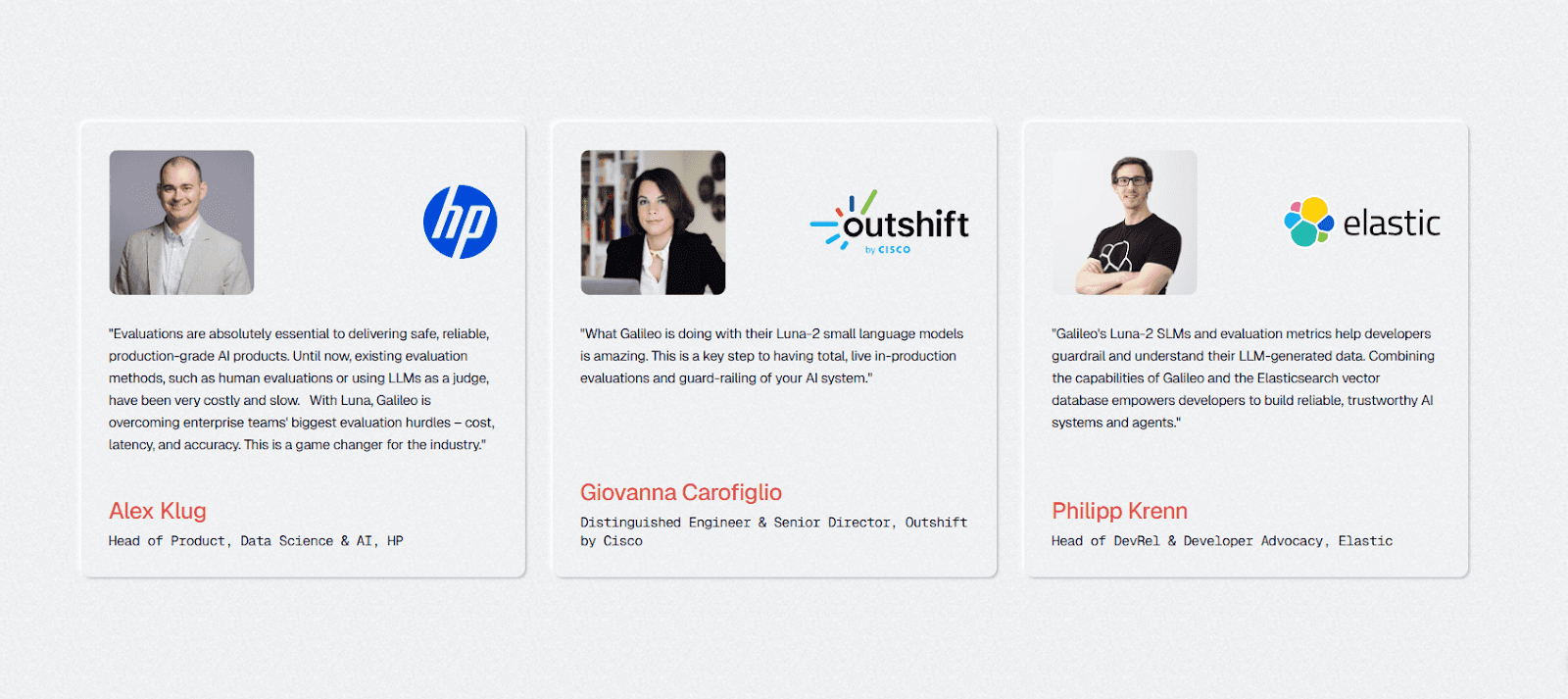
More than 100 enterprises depend on Galileo in their day-to-day operations, with names like HP, Reddit, and Comcast among them. Their documented deployments highlight how consistently the platform sustains agent reliability at scale across varied real-world setups.
Galileo maintains a 4.4 out of 5 star rating based on 17 verified reviews on G2.
One reviewer writes, “Galileo makes all the effort that is required in assessing and prototyping much easier. Non-snapshots of the model’s performance and bias are incredibly useful since they allow for frequent checkups on the model and the application of generative AI in general.”
Another user remarks, "Galileo software can help businesses save time and money, increase revenue and efficiency, and expand their business. It offers a variety of features, including: Inventory and content access: Real-time access to inventory and contents Booking, amendment, and cancellation: Book, amend, and cancel bookings online.”
Here’s what other customers say about Galileo:
Philipp Krenn, Head of DevRel & Developer Advocacy, Elastic: "Galileo's Luna-2 SLMs and evaluation metrics help developers guardrail and understand their LLM-generated data. Combining the capabilities of Galileo and the Elasticsearch vector database empowers developers to build reliable, trustworthy AI systems and agents."
Vellum AI
Some of the review for Vellum on G2 include:
“Vellum supports building AI application every step along the way, whether it's for prototyping, evaluating, deploying or observing.They stay up to date, always adding new features that support the latest trends and any new models. They also provide white glove services and can host custom model deployments.
The low code capability and drag and drop design is amazing for quickly building custom AI workflows that are production ready. Also, the ability to use PDFs as an input variable without being forced to use a document loader is great for those looking to use the computer vision capabilities of multi modal models.
Which Platform Should You Choose?
The platforms diverge on a core assumption: where does AI quality get built?
Vellum AI concentrates on prompt engineering and workflow orchestration. The platform provides versioned prompt management, A/B testing, and visual workflow builders that help teams iterate on LLM applications before deployment. Quality emerges from better prompts, tested variations, and structured development processes.
Galileo assumes prompts alone can't guarantee production reliability. Agents face inputs that no test suite anticipated. Models hallucinate despite careful prompt engineering. PII leaks through edge cases that A/B tests never surfaced. The platform builds for runtime intervention—catching failures in production milliseconds before users experience them.
Both approaches have merit. They solve different problems at different stages.
Vellum's workflow orchestration helps teams build complex LLM applications without extensive infrastructure work. Visual builders, prompt versioning, and deployment pipelines reduce the engineering overhead of managing prompt iterations across environments. For teams whose primary bottleneck is development velocity and prompt management complexity, these capabilities address real friction.
Galileo's architecture prioritizes what happens after deployment. Luna-2 small language models evaluate outputs in under 200 milliseconds—fast enough to block problematic responses before they reach users. Agent Protect intercepts hallucinations, prompt injections, and PII exposures inline. The evaluation economics make this viable at scale: $0.02 per million tokens means 100% production sampling costs $6K monthly instead of $200K with GPT-4 judges.
Choose Galileo if:
Production agents require real-time guardrails with sub-200ms blocking latency
You need runtime protection that intercepts failures before users see them
Evaluation costs must support 100% traffic sampling, not statistical subsets
Compliance requirements demand verified certifications—SOC 2, ISO 27001, GDPR
Deterministic PII redaction must execute inline, before logging or model processing
Agent-specific observability—tool selection quality, flow adherence, multi-step tracing—matters more than prompt versioning
Auto-scaling infrastructure with pay-per-trace billing fits your operational model
Forward-deployed engineering support for complex enterprise deployments adds value
Your agents process millions of daily traces and debugging time needs to compress by 20% or more
Choose Vellum AI if:
Prompt engineering and version management represent your primary development bottleneck
Visual workflow builders accelerate your team's ability to ship LLM applications
A/B testing prompt variations drives meaningful quality improvements in your use case
Development environment tooling matters more than production runtime protection
Your deployment complexity centers on managing prompt iterations across environments
Workflow orchestration without custom infrastructure investment fits your architecture
Production monitoring through alerts and logging suffices without inline blocking
The fundamental question: where do your agents fail?
If failures originate in prompt design—unclear instructions, suboptimal templates, untested variations—Vellum's development tooling addresses the root cause. Better prompts yield better outputs.
If failures emerge unpredictably in production—novel inputs, adversarial prompts, edge cases no test anticipated—development tooling can't help retroactively. You need runtime protection that operates after deployment, catching what testing missed.
For teams operating agents at enterprise scale in regulated industries, the math favors prevention. A Fortune 50 telecommunications company processes 20 million traces daily through Galileo's inline firewall. Compliance teams prove controls work because harmful data never enters the system. Manual review cycles compress from one week to two days.
Prompt engineering improves the average case. Runtime protection handles the worst case. Choose based on which failure mode keeps you up at night.
Evaluate Your LLMs and Agents with Galileo
Moving from reactive debugging to proactive quality assurance requires the right platform, one purpose-built for the complexity of modern multi-agent systems.
Here's how Galileo's comprehensive observability platform provides a unified solution:
Automated quality guardrails in CI/CD: Galileo integrates directly into your development workflow, running comprehensive evaluations on every code change and blocking releases that fail quality thresholds.
Multi-dimensional response evaluation: With Galileo's Luna-2 evaluation models, you can assess every output across dozens of quality dimensions including correctness, toxicity, bias, and adherence at 97% lower cost than traditional LLM-based evaluation approaches.
Real-time runtime protection: Galileo's Agent Protect scans every prompt and response in production, blocking harmful outputs in under 200ms before they reach users while maintaining detailed compliance logs for audit requirements.
Intelligent failure detection: Galileo's Insights Engine automatically clusters similar failures, surfaces root-cause patterns, and recommends fixes, reducing debugging time by 20% while building institutional knowledge.
Human-in-the-loop optimization: Galileo's Continuous Learning via Human Feedback transforms expert reviews into reusable evaluators, accelerating iteration while maintaining quality standards.
Agent-specific evaluation: Eight purpose-built agent evals including Tool Selection Quality, Action Completion, Agent Efficiency, and Flow Adherence catch failures unique to agentic systems that generic monitoring misses.
Explore how Galileo can help you build reliable LLMs and AI agents that users trust, and transform your testing process from reactive debugging to proactive quality assurance.
Start your free trial with 5,000 traces and see the difference prevention makes.
You're debugging an agent failure, scrolling through endless traces trying to understand why your production system chose the wrong tool. Your team shipped the update last week, but now you're facing the same question that keeps engineering leaders up at night: how do you make agent systems reliable enough to trust?
Choosing between AI platforms isn't just about feature checklists. You need infrastructure that solves actual problems—whether that's pinpointing why agents fail mysteriously, accelerating your team's development velocity, or maintaining compliance as agents make autonomous decisions.
Galileo and Vellum AI represent two distinct approaches to these challenges: observability-first versus development-first architectures. This analysis examines how each platform addresses the production realities you face daily, from evaluation rigor to deployment speed.
Galileo vs. Vellum AI At a Glance
Both platforms claim end-to-end AI lifecycle coverage, but their architectural priorities diverge significantly. Here's how they compare across dimensions that matter for production deployments:
Capability | Galileo | Vellum AI |
Primary Focus | Production observability and evaluation | Workflow orchestration and development |
Evaluation Approach | Proprietary Luna-2 models (sub-200ms latency, $0.02 per million tokens) | Reusable metrics with normalized scoring (0-1) and API-driven test execution |
Production Sampling | 100% sampling of requests | Environment-specific monitoring dashboards |
Workflow Development | SDK-based with framework-specific integrations | Visual builder with 12+ node types |
Starting Price | Free tier (5,000 traces/month), $100/month Pro (50,000 traces) | Free tier (50 builder credits/month), $25/month Pro (200 credits) |
Compliance | SOC 2 Type 2, HIPAA, GDPR | |
Deployment Options | Cloud, on-premises, hybrid with multi-region GCP | Cloud, self-hosted, hybrid with Kubernetes architecture |
Core Functionality
Evaluating AI platforms requires understanding how they handle the entire development lifecycle—from initial testing to production monitoring to runtime safety. While both platforms claim comprehensive coverage, their architectural approaches differ fundamentally.
Galileo prioritizes observability-first infrastructure with integrated evaluation and protection, while Vellum AI emphasizes rapid workflow development with embedded testing capabilities.
Galileo
Agent call chains spiral out of control fast. Traditional monitoring tools weren't built for this complexity—they show you fragments, not the full picture.
Galileo's Graph Engine changes that. It renders every tool call, prompt, and model response as an interactive map, so you see the entire conversation flow at a glance instead of piecing together logs.
But visibility alone doesn't fix problems. The Insights Engine runs continuously across all your traces, flagging hallucinations, retrieval mismatches, and tool-selection errors the moment they appear. It detects anomalies, performs root cause analysis, and surfaces suggested fixes automatically—no manual prompting, no single-trace digging. Think of it as a forward-deployed engineer monitoring your production around the clock.
Pre-built KPIs like flow adherence and tool efficacy are ready from day one. Custom metrics deploy without touching production code. Teams report 20% faster debugging—what used to consume eight hours a week now resolves in hours, not days.
When anomalies cross your thresholds, Agent Protect steps in. It blocks or rewrites problematic outputs before users ever see them. One Fortune 50 telecommunications company processes 20 million traces daily and uses Agent Protect to stop prompt injections and PII leaks in real time.
The difference? You're not running postmortems. You're preventing failures before they escape.
Vellum AI
Prompt engineers and developers often speak different languages—one wants visual tools, the other wants code. Vellum AI bridges this gap with visual workflow orchestration that generates code programmatically.
The platform's prompt engineering capabilities support dynamic construction through Jinja templating, enabling variable substitution, conditional logic, and JSON input handling. You manage custom models alongside platform-supported LLMs with version history tracking and sharing capabilities.
Rather than running tests separately from development, Vellum embeds test suites directly in workflows. Test suites contain multiple cases with defined inputs and expected outputs. Reusable metrics w/ith normalized scoring return standardized 0-1 values you can apply across test suites. API access for programmatic test execution enables CI/CD integration.
Environment isolation between development, staging, and production prevents configuration drift, while the release tagging system supports version control and A/B testing.
Technical Capabilities
Production AI systems demand more than basic API integrations—they require deep framework compatibility, multi-provider orchestration, and cost-effective evaluation at scale. How platforms handle these technical foundations directly impacts your team's ability to debug failures, manage complexity, and maintain velocity. Both platforms address these challenges through different technical architectures and integration patterns.
Galileo
Speed or accuracy—pick one. That's been the evaluation tradeoff for teams scaling agents in production. Heavyweight LLM judges like GPT-4 deliver insights, but at 2,600ms average latency, they kill any chance of real-time protection.
Luna-2 eliminates the tradeoff. These fine-tuned small language models return evaluation scores in well under 200ms—more than an order of magnitude faster than GPT-4 as a judge.
The economics are just as dramatic. At $0.02 per million tokens, Luna-2 cuts evaluation spend by 97% compared to GPT-4-based pipelines.
Let's do the math. You're processing 20 million traces daily. With GPT-4 evaluations, that's $200K per month. Luna-2 brings it to $6K—same accuracy, sub-200ms latency. That's $2.3M back in your budget annually.
And because it's 97% cheaper, you can finally afford 100% sampling instead of 10%. More coverage means catching issues before they compound.
One Fortune 50 telecommunications company made the switch and reduced evaluation infrastructure costs from $27 million to under $1 million.
Luna-2 gets smarter over time. Continuous Learning via Human Feedback automatically fine-tunes the models on your domain data as patterns shift. The multi-headed architecture runs hundreds of metrics—toxicity, adherence, tool selection quality—on shared infrastructure without spawning new GPU workers.
Here's where it comes together: today's evaluations become tomorrow's guardrails. Offline eval testing transitions to online monitoring, which converts into runtime blocking guardrails with sub-150ms latency checkpoints in live applications.
Real-time protection at production scale isn't a budget-breaker anymore. It's the default.
Vellum AI
You're maintaining separate authentication systems, implementing provider-specific error handling, and updating integration code every time a provider changes their API when managing multiple LLM providers. This overhead compounds as you adopt Claude, GPT, Gemini, and custom models simultaneously.
Vellum AI eliminates this by supporting 20+ LLM models across 6+ providers through one unified interface, including Anthropic's Claude 4 series (up to 200,000 token context), OpenAI's GPT-5 variants, Google's Gemini 3 Pro (10M token context), Meta's Llama 4, Amazon Nova, Cohere, Grok 4, DeepSeek, and Qwen models. Enterprise options include BYOM (Bring Your Own Model) support and private model deployments.
Your variable definitions scatter across codebases with traditional prompt engineering. Vellum's templating approach centralizes this with {{variable_name}} syntax and full Jinja support, letting you define variables once and reuse them across multiple prompt versions without code changes. Function calling enables structured outputs while variable interpolation works across chat model blocks.
Traditional workflow development often requires separate diagramming and implementation phases, forcing you to maintain documentation alongside code.
Integration and Scalability
Moving from prototype to production reveals whether platforms scale with your growth or become bottlenecks. API architecture, deployment flexibility, and proven performance metrics separate platforms that claim enterprise readiness from those that deliver it.
Understanding how each platform handles increasing request volumes, framework integrations, and deployment complexity determines whether you're building on infrastructure that scales or one that constrains future growth.
Galileo
Your agent fails in production. Now you're scrolling through deployment logs, trying to piece together what happened. Sound familiar?
Most teams burn weeks on manual instrumentation—schema mapping across frameworks, custom telemetry for each integration. By the time you're operational, you've lost a sprint.
Galileo's auto-instrumentation drops into your codebase in a single line. The SDK detects calls from LangChain, LlamaIndex, or raw OpenAI APIs and starts streaming metrics instantly. No custom configuration. No weeks of setup. You're instrumenting in minutes.
Once data flows, a serverless backend handles the rest. It scales elastically—millions of traces daily without provisioning or capacity planning on your end.
You choose where it runs. Fully managed SaaS when speed matters. Private VPC for regulated workloads. On-prem when data can't leave your walls.
Here's what stays constant: the APIs. Your dev team works in SaaS. Your compliance team requires on-prem for production. Your code doesn't change. CI/CD pipelines stay intact across every deployment model.
Procurement doesn't have to stall releases either. Marketplace listings mean you skip the approval bottleneck.
When traffic spikes—say, an unexpected product launch drives 10x volume overnight—auto-scaling keeps you covered. Pay-as-you-go billing means costs scale linearly, not exponentially. No over-provisioning. No budget surprises.
Your infrastructure flexes. Your code stays clean. Your team ships.
Vellum AI
Vellum AI provides unified API access across multiple LLM providers through Prompt Node invocations in workflows. One-click deployment supports closed-source, open-source, and self-hosted models without managing provider-specific integrations.
Deployment models include cloud-based, self-hosted, and hybrid configurations. Self-hosted deployment delivers complete platform control within your infrastructure with air-gapped environment support for highly regulated industries.
Technical stack combines Kubernetes for container orchestration, PostgreSQL for relational data storage, Clickhouse for analytics, and Python SDK for programmatic access. Vellum's team provides architecture planning and ongoing technical assistance for installation and configuration.
The testing framework scales across 10+ simultaneous scenarios with performance testing, regression validation, and quality metrics measuring AI system behavior across diverse cases. Production monitoring tracks request volume, average latency, quality scores, error rates, and usage analytics through environment-specific dashboards. You identify performance bottlenecks and scale resources appropriately as traffic patterns evolve.
Compliance and Security
Regulated industries can't compromise on security certifications, audit capabilities, or data governance—a single compliance gap blocks enterprise adoption regardless of technical capabilities.
Healthcare organizations processing PHI, financial institutions handling transaction data, and European companies subject to GDPR require specific certifications and controls. Both platforms address enterprise security requirements, though with different certification coverage and varying levels of public documentation transparency.
Galileo
Regulated industries don't get to move fast and break things. When you're handling patient records or financial account numbers, "we'll fix it in the next sprint" isn't an option.
Galileo is built for these environments. SOC 2, ISO 27001, and GDPR compliance come standard—certifications that satisfy audit requirements and demonstrate commitment to data protection from day one.
Encryption covers both ends. AES 256 protects data at rest. TLS 1.2+ secures data in transit. No gaps between storage and transmission.
But certifications and encryption are table stakes. What separates Galileo is deterministic PII redaction—and how it works.
Sensitive information gets identified and redacted automatically, in real-time. This isn't batch processing that runs overnight. It happens inline, before data reaches the model or gets stored in logs.
That distinction matters for banking and healthcare. These industries need blocking capability, not just detection. When a prompt accidentally contains patient information or financial account numbers, Galileo's runtime protection redacts it in under 200ms. The harmful data never enters the system. Compliance teams can prove controls work because there's nothing to remediate after the fact.
Data residency requirements get the same treatment. On-premise and sovereign-ready deployment options let you store and process data within specified jurisdictions. Your observability platform deploys in the same AWS region, Azure tenant, or private data center as your production workloads. Data doesn't cross borders it shouldn't.
For enterprise customers navigating complex compliance requirements, six forward-deployed engineers provide hands-on support—audit preparation, security reviews, custom deployment architectures. Not a help desk. Direct guidance from people who've done this before.
Security isn't a feature page. It's how the platform operates.
Vellum AI
Enterprise AI deployments must satisfy multiple compliance frameworks simultaneously—SOC 2 for security controls, HIPAA for healthcare data, GDPR for European operations. Vellum AI maintains all three certifications plus Business Associate Agreements for healthcare organizations.
Security controls include AES-256 GCM encryption for data at rest, TLS/HTTPS encryption for all transmission, and mandatory API authentication. However, like Galileo, the actual SOC 2 attestation report isn't publicly available and must be requested from Vellum directly.
Role-Based Access Control provides six distinct permission levels: Admin with full system access including billing, Deployment Editor for creating and deploying production workflows, Document Index Editor for knowledge base management, Test Suite Editor for evaluation creation, Playground Editor for sandbox experimentation, and Member for read-only access. Webhook security supports optional HMAC authentication for event verification. Enterprise plans include Single Sign-On with SAML and SCIM support.
Data privacy protections specifically address LLM provider concerns—only prompt content transmits to third-party providers with no metadata, user information, or system data shared. All transmission uses encrypted channels and user data explicitly isn't used for LLM training, protecting proprietary information.
Usability and Cost
Platform pricing and learning curves directly impact adoption velocity and total cost of ownership. Free tiers enable validation before financial commitment, but scaling from prototype to production reveals the real costs. Implementation complexity determines whether your team ships features or struggles with integration, while collaboration capabilities affect cross-functional velocity between engineers, product managers, and executives.
Galileo
Most observability platforms make you work for insights. Complex queries. Expensive LLM judgments. Weeks before you see value.
Galileo flips that. Point your agent traffic at the SDK, and no-code metric builders let you create guardrails and custom KPIs without writing evaluators. No SQL. No data science degree. You're building within your first day.
A free tier covers 5,000 traces—real production data, not synthetic demos. You validate value before contracts begin.
When you scale beyond the sandbox, Luna-2 keeps costs flat. At $0.02 per million tokens, it's 97% cheaper than GPT-4. That economic advantage compounds as you grow.
But cost savings mean nothing if only engineers can use the platform. Galileo centralizes everything in one hub: prompt version comparisons, annotations, alerts. Product managers, domain experts, and engineers work in the same console. Your finance team can validate agent behavior for expense report processing without waiting on engineering. That democratization matters when you're scaling from two applications to twenty.
The backend auto-scales to match your reality. Traffic drops over weekends? Costs drop. Product launch spikes volume? The platform absorbs it. You pay for traces processed, not infrastructure capacity. No GPU provisioning headaches. No surprise overruns.
This drives lower total cost of ownership through automation—not additional headcount.
The results show up fast. Customers report reducing manual review time from one week to two days. Evaluation cycles shrink by 75%. Human-in-the-loop validation workflows run 60% faster.
The tool pays for itself. Then it keeps compounding.
Vellum AI
Vellum's pricing begins with a free tier offering 50 builder credits monthly for single users, up to 3 hosted agent apps, and 20 documents monthly with 7-day retention—suitable for initial platform exploration.
The Pro tier costs $25 monthly for 200 builder credits with debugging console, 3 parallel agent runs, 30-minute max runtime, and 30-day retention, representing the minimum viable tier for serious development work.
Business tier at $79 per user monthly (up to 5 users) provides 500 credits per user, unlimited hosted apps, 10 GB execution history, and up to 1-year data retention—the minimum viable option for engineering team collaboration requiring compliance and longitudinal analysis. Enterprise pricing is custom with unlimited resources, RBAC, SSO, isolated environments, VPC installation, and dedicated support.
Implementation requires Python 3.9+ with standard package management through uv or pip. Installation follows uv add vellum-ai or pip install vellum-ai patterns with API key authentication via environment variables. Official SDKs for Python, Node/TypeScript, and Go support diverse technology stacks.
The trade-off centers on development paradigms—visual builders accelerate prototyping but may require workflow adjustment for code-first teams preferring infrastructure-as-code approaches.
What Customers Say
Feature specs are helpful, but production tells the truth. Independent reviews and real-world deployments show how each platform manages live agent workflows under true enterprise demands.
Galileo

More than 100 enterprises depend on Galileo in their day-to-day operations, with names like HP, Reddit, and Comcast among them. Their documented deployments highlight how consistently the platform sustains agent reliability at scale across varied real-world setups.
Galileo maintains a 4.4 out of 5 star rating based on 17 verified reviews on G2.
One reviewer writes, “Galileo makes all the effort that is required in assessing and prototyping much easier. Non-snapshots of the model’s performance and bias are incredibly useful since they allow for frequent checkups on the model and the application of generative AI in general.”
Another user remarks, "Galileo software can help businesses save time and money, increase revenue and efficiency, and expand their business. It offers a variety of features, including: Inventory and content access: Real-time access to inventory and contents Booking, amendment, and cancellation: Book, amend, and cancel bookings online.”
Here’s what other customers say about Galileo:
Philipp Krenn, Head of DevRel & Developer Advocacy, Elastic: "Galileo's Luna-2 SLMs and evaluation metrics help developers guardrail and understand their LLM-generated data. Combining the capabilities of Galileo and the Elasticsearch vector database empowers developers to build reliable, trustworthy AI systems and agents."
Vellum AI
Some of the review for Vellum on G2 include:
“Vellum supports building AI application every step along the way, whether it's for prototyping, evaluating, deploying or observing.They stay up to date, always adding new features that support the latest trends and any new models. They also provide white glove services and can host custom model deployments.
The low code capability and drag and drop design is amazing for quickly building custom AI workflows that are production ready. Also, the ability to use PDFs as an input variable without being forced to use a document loader is great for those looking to use the computer vision capabilities of multi modal models.
Which Platform Should You Choose?
The platforms diverge on a core assumption: where does AI quality get built?
Vellum AI concentrates on prompt engineering and workflow orchestration. The platform provides versioned prompt management, A/B testing, and visual workflow builders that help teams iterate on LLM applications before deployment. Quality emerges from better prompts, tested variations, and structured development processes.
Galileo assumes prompts alone can't guarantee production reliability. Agents face inputs that no test suite anticipated. Models hallucinate despite careful prompt engineering. PII leaks through edge cases that A/B tests never surfaced. The platform builds for runtime intervention—catching failures in production milliseconds before users experience them.
Both approaches have merit. They solve different problems at different stages.
Vellum's workflow orchestration helps teams build complex LLM applications without extensive infrastructure work. Visual builders, prompt versioning, and deployment pipelines reduce the engineering overhead of managing prompt iterations across environments. For teams whose primary bottleneck is development velocity and prompt management complexity, these capabilities address real friction.
Galileo's architecture prioritizes what happens after deployment. Luna-2 small language models evaluate outputs in under 200 milliseconds—fast enough to block problematic responses before they reach users. Agent Protect intercepts hallucinations, prompt injections, and PII exposures inline. The evaluation economics make this viable at scale: $0.02 per million tokens means 100% production sampling costs $6K monthly instead of $200K with GPT-4 judges.
Choose Galileo if:
Production agents require real-time guardrails with sub-200ms blocking latency
You need runtime protection that intercepts failures before users see them
Evaluation costs must support 100% traffic sampling, not statistical subsets
Compliance requirements demand verified certifications—SOC 2, ISO 27001, GDPR
Deterministic PII redaction must execute inline, before logging or model processing
Agent-specific observability—tool selection quality, flow adherence, multi-step tracing—matters more than prompt versioning
Auto-scaling infrastructure with pay-per-trace billing fits your operational model
Forward-deployed engineering support for complex enterprise deployments adds value
Your agents process millions of daily traces and debugging time needs to compress by 20% or more
Choose Vellum AI if:
Prompt engineering and version management represent your primary development bottleneck
Visual workflow builders accelerate your team's ability to ship LLM applications
A/B testing prompt variations drives meaningful quality improvements in your use case
Development environment tooling matters more than production runtime protection
Your deployment complexity centers on managing prompt iterations across environments
Workflow orchestration without custom infrastructure investment fits your architecture
Production monitoring through alerts and logging suffices without inline blocking
The fundamental question: where do your agents fail?
If failures originate in prompt design—unclear instructions, suboptimal templates, untested variations—Vellum's development tooling addresses the root cause. Better prompts yield better outputs.
If failures emerge unpredictably in production—novel inputs, adversarial prompts, edge cases no test anticipated—development tooling can't help retroactively. You need runtime protection that operates after deployment, catching what testing missed.
For teams operating agents at enterprise scale in regulated industries, the math favors prevention. A Fortune 50 telecommunications company processes 20 million traces daily through Galileo's inline firewall. Compliance teams prove controls work because harmful data never enters the system. Manual review cycles compress from one week to two days.
Prompt engineering improves the average case. Runtime protection handles the worst case. Choose based on which failure mode keeps you up at night.
Evaluate Your LLMs and Agents with Galileo
Moving from reactive debugging to proactive quality assurance requires the right platform, one purpose-built for the complexity of modern multi-agent systems.
Here's how Galileo's comprehensive observability platform provides a unified solution:
Automated quality guardrails in CI/CD: Galileo integrates directly into your development workflow, running comprehensive evaluations on every code change and blocking releases that fail quality thresholds.
Multi-dimensional response evaluation: With Galileo's Luna-2 evaluation models, you can assess every output across dozens of quality dimensions including correctness, toxicity, bias, and adherence at 97% lower cost than traditional LLM-based evaluation approaches.
Real-time runtime protection: Galileo's Agent Protect scans every prompt and response in production, blocking harmful outputs in under 200ms before they reach users while maintaining detailed compliance logs for audit requirements.
Intelligent failure detection: Galileo's Insights Engine automatically clusters similar failures, surfaces root-cause patterns, and recommends fixes, reducing debugging time by 20% while building institutional knowledge.
Human-in-the-loop optimization: Galileo's Continuous Learning via Human Feedback transforms expert reviews into reusable evaluators, accelerating iteration while maintaining quality standards.
Agent-specific evaluation: Eight purpose-built agent evals including Tool Selection Quality, Action Completion, Agent Efficiency, and Flow Adherence catch failures unique to agentic systems that generic monitoring misses.
Explore how Galileo can help you build reliable LLMs and AI agents that users trust, and transform your testing process from reactive debugging to proactive quality assurance.
Start your free trial with 5,000 traces and see the difference prevention makes.
You're debugging an agent failure, scrolling through endless traces trying to understand why your production system chose the wrong tool. Your team shipped the update last week, but now you're facing the same question that keeps engineering leaders up at night: how do you make agent systems reliable enough to trust?
Choosing between AI platforms isn't just about feature checklists. You need infrastructure that solves actual problems—whether that's pinpointing why agents fail mysteriously, accelerating your team's development velocity, or maintaining compliance as agents make autonomous decisions.
Galileo and Vellum AI represent two distinct approaches to these challenges: observability-first versus development-first architectures. This analysis examines how each platform addresses the production realities you face daily, from evaluation rigor to deployment speed.
Galileo vs. Vellum AI At a Glance
Both platforms claim end-to-end AI lifecycle coverage, but their architectural priorities diverge significantly. Here's how they compare across dimensions that matter for production deployments:
Capability | Galileo | Vellum AI |
Primary Focus | Production observability and evaluation | Workflow orchestration and development |
Evaluation Approach | Proprietary Luna-2 models (sub-200ms latency, $0.02 per million tokens) | Reusable metrics with normalized scoring (0-1) and API-driven test execution |
Production Sampling | 100% sampling of requests | Environment-specific monitoring dashboards |
Workflow Development | SDK-based with framework-specific integrations | Visual builder with 12+ node types |
Starting Price | Free tier (5,000 traces/month), $100/month Pro (50,000 traces) | Free tier (50 builder credits/month), $25/month Pro (200 credits) |
Compliance | SOC 2 Type 2, HIPAA, GDPR | |
Deployment Options | Cloud, on-premises, hybrid with multi-region GCP | Cloud, self-hosted, hybrid with Kubernetes architecture |
Core Functionality
Evaluating AI platforms requires understanding how they handle the entire development lifecycle—from initial testing to production monitoring to runtime safety. While both platforms claim comprehensive coverage, their architectural approaches differ fundamentally.
Galileo prioritizes observability-first infrastructure with integrated evaluation and protection, while Vellum AI emphasizes rapid workflow development with embedded testing capabilities.
Galileo
Agent call chains spiral out of control fast. Traditional monitoring tools weren't built for this complexity—they show you fragments, not the full picture.
Galileo's Graph Engine changes that. It renders every tool call, prompt, and model response as an interactive map, so you see the entire conversation flow at a glance instead of piecing together logs.
But visibility alone doesn't fix problems. The Insights Engine runs continuously across all your traces, flagging hallucinations, retrieval mismatches, and tool-selection errors the moment they appear. It detects anomalies, performs root cause analysis, and surfaces suggested fixes automatically—no manual prompting, no single-trace digging. Think of it as a forward-deployed engineer monitoring your production around the clock.
Pre-built KPIs like flow adherence and tool efficacy are ready from day one. Custom metrics deploy without touching production code. Teams report 20% faster debugging—what used to consume eight hours a week now resolves in hours, not days.
When anomalies cross your thresholds, Agent Protect steps in. It blocks or rewrites problematic outputs before users ever see them. One Fortune 50 telecommunications company processes 20 million traces daily and uses Agent Protect to stop prompt injections and PII leaks in real time.
The difference? You're not running postmortems. You're preventing failures before they escape.
Vellum AI
Prompt engineers and developers often speak different languages—one wants visual tools, the other wants code. Vellum AI bridges this gap with visual workflow orchestration that generates code programmatically.
The platform's prompt engineering capabilities support dynamic construction through Jinja templating, enabling variable substitution, conditional logic, and JSON input handling. You manage custom models alongside platform-supported LLMs with version history tracking and sharing capabilities.
Rather than running tests separately from development, Vellum embeds test suites directly in workflows. Test suites contain multiple cases with defined inputs and expected outputs. Reusable metrics w/ith normalized scoring return standardized 0-1 values you can apply across test suites. API access for programmatic test execution enables CI/CD integration.
Environment isolation between development, staging, and production prevents configuration drift, while the release tagging system supports version control and A/B testing.
Technical Capabilities
Production AI systems demand more than basic API integrations—they require deep framework compatibility, multi-provider orchestration, and cost-effective evaluation at scale. How platforms handle these technical foundations directly impacts your team's ability to debug failures, manage complexity, and maintain velocity. Both platforms address these challenges through different technical architectures and integration patterns.
Galileo
Speed or accuracy—pick one. That's been the evaluation tradeoff for teams scaling agents in production. Heavyweight LLM judges like GPT-4 deliver insights, but at 2,600ms average latency, they kill any chance of real-time protection.
Luna-2 eliminates the tradeoff. These fine-tuned small language models return evaluation scores in well under 200ms—more than an order of magnitude faster than GPT-4 as a judge.
The economics are just as dramatic. At $0.02 per million tokens, Luna-2 cuts evaluation spend by 97% compared to GPT-4-based pipelines.
Let's do the math. You're processing 20 million traces daily. With GPT-4 evaluations, that's $200K per month. Luna-2 brings it to $6K—same accuracy, sub-200ms latency. That's $2.3M back in your budget annually.
And because it's 97% cheaper, you can finally afford 100% sampling instead of 10%. More coverage means catching issues before they compound.
One Fortune 50 telecommunications company made the switch and reduced evaluation infrastructure costs from $27 million to under $1 million.
Luna-2 gets smarter over time. Continuous Learning via Human Feedback automatically fine-tunes the models on your domain data as patterns shift. The multi-headed architecture runs hundreds of metrics—toxicity, adherence, tool selection quality—on shared infrastructure without spawning new GPU workers.
Here's where it comes together: today's evaluations become tomorrow's guardrails. Offline eval testing transitions to online monitoring, which converts into runtime blocking guardrails with sub-150ms latency checkpoints in live applications.
Real-time protection at production scale isn't a budget-breaker anymore. It's the default.
Vellum AI
You're maintaining separate authentication systems, implementing provider-specific error handling, and updating integration code every time a provider changes their API when managing multiple LLM providers. This overhead compounds as you adopt Claude, GPT, Gemini, and custom models simultaneously.
Vellum AI eliminates this by supporting 20+ LLM models across 6+ providers through one unified interface, including Anthropic's Claude 4 series (up to 200,000 token context), OpenAI's GPT-5 variants, Google's Gemini 3 Pro (10M token context), Meta's Llama 4, Amazon Nova, Cohere, Grok 4, DeepSeek, and Qwen models. Enterprise options include BYOM (Bring Your Own Model) support and private model deployments.
Your variable definitions scatter across codebases with traditional prompt engineering. Vellum's templating approach centralizes this with {{variable_name}} syntax and full Jinja support, letting you define variables once and reuse them across multiple prompt versions without code changes. Function calling enables structured outputs while variable interpolation works across chat model blocks.
Traditional workflow development often requires separate diagramming and implementation phases, forcing you to maintain documentation alongside code.
Integration and Scalability
Moving from prototype to production reveals whether platforms scale with your growth or become bottlenecks. API architecture, deployment flexibility, and proven performance metrics separate platforms that claim enterprise readiness from those that deliver it.
Understanding how each platform handles increasing request volumes, framework integrations, and deployment complexity determines whether you're building on infrastructure that scales or one that constrains future growth.
Galileo
Your agent fails in production. Now you're scrolling through deployment logs, trying to piece together what happened. Sound familiar?
Most teams burn weeks on manual instrumentation—schema mapping across frameworks, custom telemetry for each integration. By the time you're operational, you've lost a sprint.
Galileo's auto-instrumentation drops into your codebase in a single line. The SDK detects calls from LangChain, LlamaIndex, or raw OpenAI APIs and starts streaming metrics instantly. No custom configuration. No weeks of setup. You're instrumenting in minutes.
Once data flows, a serverless backend handles the rest. It scales elastically—millions of traces daily without provisioning or capacity planning on your end.
You choose where it runs. Fully managed SaaS when speed matters. Private VPC for regulated workloads. On-prem when data can't leave your walls.
Here's what stays constant: the APIs. Your dev team works in SaaS. Your compliance team requires on-prem for production. Your code doesn't change. CI/CD pipelines stay intact across every deployment model.
Procurement doesn't have to stall releases either. Marketplace listings mean you skip the approval bottleneck.
When traffic spikes—say, an unexpected product launch drives 10x volume overnight—auto-scaling keeps you covered. Pay-as-you-go billing means costs scale linearly, not exponentially. No over-provisioning. No budget surprises.
Your infrastructure flexes. Your code stays clean. Your team ships.
Vellum AI
Vellum AI provides unified API access across multiple LLM providers through Prompt Node invocations in workflows. One-click deployment supports closed-source, open-source, and self-hosted models without managing provider-specific integrations.
Deployment models include cloud-based, self-hosted, and hybrid configurations. Self-hosted deployment delivers complete platform control within your infrastructure with air-gapped environment support for highly regulated industries.
Technical stack combines Kubernetes for container orchestration, PostgreSQL for relational data storage, Clickhouse for analytics, and Python SDK for programmatic access. Vellum's team provides architecture planning and ongoing technical assistance for installation and configuration.
The testing framework scales across 10+ simultaneous scenarios with performance testing, regression validation, and quality metrics measuring AI system behavior across diverse cases. Production monitoring tracks request volume, average latency, quality scores, error rates, and usage analytics through environment-specific dashboards. You identify performance bottlenecks and scale resources appropriately as traffic patterns evolve.
Compliance and Security
Regulated industries can't compromise on security certifications, audit capabilities, or data governance—a single compliance gap blocks enterprise adoption regardless of technical capabilities.
Healthcare organizations processing PHI, financial institutions handling transaction data, and European companies subject to GDPR require specific certifications and controls. Both platforms address enterprise security requirements, though with different certification coverage and varying levels of public documentation transparency.
Galileo
Regulated industries don't get to move fast and break things. When you're handling patient records or financial account numbers, "we'll fix it in the next sprint" isn't an option.
Galileo is built for these environments. SOC 2, ISO 27001, and GDPR compliance come standard—certifications that satisfy audit requirements and demonstrate commitment to data protection from day one.
Encryption covers both ends. AES 256 protects data at rest. TLS 1.2+ secures data in transit. No gaps between storage and transmission.
But certifications and encryption are table stakes. What separates Galileo is deterministic PII redaction—and how it works.
Sensitive information gets identified and redacted automatically, in real-time. This isn't batch processing that runs overnight. It happens inline, before data reaches the model or gets stored in logs.
That distinction matters for banking and healthcare. These industries need blocking capability, not just detection. When a prompt accidentally contains patient information or financial account numbers, Galileo's runtime protection redacts it in under 200ms. The harmful data never enters the system. Compliance teams can prove controls work because there's nothing to remediate after the fact.
Data residency requirements get the same treatment. On-premise and sovereign-ready deployment options let you store and process data within specified jurisdictions. Your observability platform deploys in the same AWS region, Azure tenant, or private data center as your production workloads. Data doesn't cross borders it shouldn't.
For enterprise customers navigating complex compliance requirements, six forward-deployed engineers provide hands-on support—audit preparation, security reviews, custom deployment architectures. Not a help desk. Direct guidance from people who've done this before.
Security isn't a feature page. It's how the platform operates.
Vellum AI
Enterprise AI deployments must satisfy multiple compliance frameworks simultaneously—SOC 2 for security controls, HIPAA for healthcare data, GDPR for European operations. Vellum AI maintains all three certifications plus Business Associate Agreements for healthcare organizations.
Security controls include AES-256 GCM encryption for data at rest, TLS/HTTPS encryption for all transmission, and mandatory API authentication. However, like Galileo, the actual SOC 2 attestation report isn't publicly available and must be requested from Vellum directly.
Role-Based Access Control provides six distinct permission levels: Admin with full system access including billing, Deployment Editor for creating and deploying production workflows, Document Index Editor for knowledge base management, Test Suite Editor for evaluation creation, Playground Editor for sandbox experimentation, and Member for read-only access. Webhook security supports optional HMAC authentication for event verification. Enterprise plans include Single Sign-On with SAML and SCIM support.
Data privacy protections specifically address LLM provider concerns—only prompt content transmits to third-party providers with no metadata, user information, or system data shared. All transmission uses encrypted channels and user data explicitly isn't used for LLM training, protecting proprietary information.
Usability and Cost
Platform pricing and learning curves directly impact adoption velocity and total cost of ownership. Free tiers enable validation before financial commitment, but scaling from prototype to production reveals the real costs. Implementation complexity determines whether your team ships features or struggles with integration, while collaboration capabilities affect cross-functional velocity between engineers, product managers, and executives.
Galileo
Most observability platforms make you work for insights. Complex queries. Expensive LLM judgments. Weeks before you see value.
Galileo flips that. Point your agent traffic at the SDK, and no-code metric builders let you create guardrails and custom KPIs without writing evaluators. No SQL. No data science degree. You're building within your first day.
A free tier covers 5,000 traces—real production data, not synthetic demos. You validate value before contracts begin.
When you scale beyond the sandbox, Luna-2 keeps costs flat. At $0.02 per million tokens, it's 97% cheaper than GPT-4. That economic advantage compounds as you grow.
But cost savings mean nothing if only engineers can use the platform. Galileo centralizes everything in one hub: prompt version comparisons, annotations, alerts. Product managers, domain experts, and engineers work in the same console. Your finance team can validate agent behavior for expense report processing without waiting on engineering. That democratization matters when you're scaling from two applications to twenty.
The backend auto-scales to match your reality. Traffic drops over weekends? Costs drop. Product launch spikes volume? The platform absorbs it. You pay for traces processed, not infrastructure capacity. No GPU provisioning headaches. No surprise overruns.
This drives lower total cost of ownership through automation—not additional headcount.
The results show up fast. Customers report reducing manual review time from one week to two days. Evaluation cycles shrink by 75%. Human-in-the-loop validation workflows run 60% faster.
The tool pays for itself. Then it keeps compounding.
Vellum AI
Vellum's pricing begins with a free tier offering 50 builder credits monthly for single users, up to 3 hosted agent apps, and 20 documents monthly with 7-day retention—suitable for initial platform exploration.
The Pro tier costs $25 monthly for 200 builder credits with debugging console, 3 parallel agent runs, 30-minute max runtime, and 30-day retention, representing the minimum viable tier for serious development work.
Business tier at $79 per user monthly (up to 5 users) provides 500 credits per user, unlimited hosted apps, 10 GB execution history, and up to 1-year data retention—the minimum viable option for engineering team collaboration requiring compliance and longitudinal analysis. Enterprise pricing is custom with unlimited resources, RBAC, SSO, isolated environments, VPC installation, and dedicated support.
Implementation requires Python 3.9+ with standard package management through uv or pip. Installation follows uv add vellum-ai or pip install vellum-ai patterns with API key authentication via environment variables. Official SDKs for Python, Node/TypeScript, and Go support diverse technology stacks.
The trade-off centers on development paradigms—visual builders accelerate prototyping but may require workflow adjustment for code-first teams preferring infrastructure-as-code approaches.
What Customers Say
Feature specs are helpful, but production tells the truth. Independent reviews and real-world deployments show how each platform manages live agent workflows under true enterprise demands.
Galileo

More than 100 enterprises depend on Galileo in their day-to-day operations, with names like HP, Reddit, and Comcast among them. Their documented deployments highlight how consistently the platform sustains agent reliability at scale across varied real-world setups.
Galileo maintains a 4.4 out of 5 star rating based on 17 verified reviews on G2.
One reviewer writes, “Galileo makes all the effort that is required in assessing and prototyping much easier. Non-snapshots of the model’s performance and bias are incredibly useful since they allow for frequent checkups on the model and the application of generative AI in general.”
Another user remarks, "Galileo software can help businesses save time and money, increase revenue and efficiency, and expand their business. It offers a variety of features, including: Inventory and content access: Real-time access to inventory and contents Booking, amendment, and cancellation: Book, amend, and cancel bookings online.”
Here’s what other customers say about Galileo:
Philipp Krenn, Head of DevRel & Developer Advocacy, Elastic: "Galileo's Luna-2 SLMs and evaluation metrics help developers guardrail and understand their LLM-generated data. Combining the capabilities of Galileo and the Elasticsearch vector database empowers developers to build reliable, trustworthy AI systems and agents."
Vellum AI
Some of the review for Vellum on G2 include:
“Vellum supports building AI application every step along the way, whether it's for prototyping, evaluating, deploying or observing.They stay up to date, always adding new features that support the latest trends and any new models. They also provide white glove services and can host custom model deployments.
The low code capability and drag and drop design is amazing for quickly building custom AI workflows that are production ready. Also, the ability to use PDFs as an input variable without being forced to use a document loader is great for those looking to use the computer vision capabilities of multi modal models.
Which Platform Should You Choose?
The platforms diverge on a core assumption: where does AI quality get built?
Vellum AI concentrates on prompt engineering and workflow orchestration. The platform provides versioned prompt management, A/B testing, and visual workflow builders that help teams iterate on LLM applications before deployment. Quality emerges from better prompts, tested variations, and structured development processes.
Galileo assumes prompts alone can't guarantee production reliability. Agents face inputs that no test suite anticipated. Models hallucinate despite careful prompt engineering. PII leaks through edge cases that A/B tests never surfaced. The platform builds for runtime intervention—catching failures in production milliseconds before users experience them.
Both approaches have merit. They solve different problems at different stages.
Vellum's workflow orchestration helps teams build complex LLM applications without extensive infrastructure work. Visual builders, prompt versioning, and deployment pipelines reduce the engineering overhead of managing prompt iterations across environments. For teams whose primary bottleneck is development velocity and prompt management complexity, these capabilities address real friction.
Galileo's architecture prioritizes what happens after deployment. Luna-2 small language models evaluate outputs in under 200 milliseconds—fast enough to block problematic responses before they reach users. Agent Protect intercepts hallucinations, prompt injections, and PII exposures inline. The evaluation economics make this viable at scale: $0.02 per million tokens means 100% production sampling costs $6K monthly instead of $200K with GPT-4 judges.
Choose Galileo if:
Production agents require real-time guardrails with sub-200ms blocking latency
You need runtime protection that intercepts failures before users see them
Evaluation costs must support 100% traffic sampling, not statistical subsets
Compliance requirements demand verified certifications—SOC 2, ISO 27001, GDPR
Deterministic PII redaction must execute inline, before logging or model processing
Agent-specific observability—tool selection quality, flow adherence, multi-step tracing—matters more than prompt versioning
Auto-scaling infrastructure with pay-per-trace billing fits your operational model
Forward-deployed engineering support for complex enterprise deployments adds value
Your agents process millions of daily traces and debugging time needs to compress by 20% or more
Choose Vellum AI if:
Prompt engineering and version management represent your primary development bottleneck
Visual workflow builders accelerate your team's ability to ship LLM applications
A/B testing prompt variations drives meaningful quality improvements in your use case
Development environment tooling matters more than production runtime protection
Your deployment complexity centers on managing prompt iterations across environments
Workflow orchestration without custom infrastructure investment fits your architecture
Production monitoring through alerts and logging suffices without inline blocking
The fundamental question: where do your agents fail?
If failures originate in prompt design—unclear instructions, suboptimal templates, untested variations—Vellum's development tooling addresses the root cause. Better prompts yield better outputs.
If failures emerge unpredictably in production—novel inputs, adversarial prompts, edge cases no test anticipated—development tooling can't help retroactively. You need runtime protection that operates after deployment, catching what testing missed.
For teams operating agents at enterprise scale in regulated industries, the math favors prevention. A Fortune 50 telecommunications company processes 20 million traces daily through Galileo's inline firewall. Compliance teams prove controls work because harmful data never enters the system. Manual review cycles compress from one week to two days.
Prompt engineering improves the average case. Runtime protection handles the worst case. Choose based on which failure mode keeps you up at night.
Evaluate Your LLMs and Agents with Galileo
Moving from reactive debugging to proactive quality assurance requires the right platform, one purpose-built for the complexity of modern multi-agent systems.
Here's how Galileo's comprehensive observability platform provides a unified solution:
Automated quality guardrails in CI/CD: Galileo integrates directly into your development workflow, running comprehensive evaluations on every code change and blocking releases that fail quality thresholds.
Multi-dimensional response evaluation: With Galileo's Luna-2 evaluation models, you can assess every output across dozens of quality dimensions including correctness, toxicity, bias, and adherence at 97% lower cost than traditional LLM-based evaluation approaches.
Real-time runtime protection: Galileo's Agent Protect scans every prompt and response in production, blocking harmful outputs in under 200ms before they reach users while maintaining detailed compliance logs for audit requirements.
Intelligent failure detection: Galileo's Insights Engine automatically clusters similar failures, surfaces root-cause patterns, and recommends fixes, reducing debugging time by 20% while building institutional knowledge.
Human-in-the-loop optimization: Galileo's Continuous Learning via Human Feedback transforms expert reviews into reusable evaluators, accelerating iteration while maintaining quality standards.
Agent-specific evaluation: Eight purpose-built agent evals including Tool Selection Quality, Action Completion, Agent Efficiency, and Flow Adherence catch failures unique to agentic systems that generic monitoring misses.
Explore how Galileo can help you build reliable LLMs and AI agents that users trust, and transform your testing process from reactive debugging to proactive quality assurance.
Start your free trial with 5,000 traces and see the difference prevention makes.
You're debugging an agent failure, scrolling through endless traces trying to understand why your production system chose the wrong tool. Your team shipped the update last week, but now you're facing the same question that keeps engineering leaders up at night: how do you make agent systems reliable enough to trust?
Choosing between AI platforms isn't just about feature checklists. You need infrastructure that solves actual problems—whether that's pinpointing why agents fail mysteriously, accelerating your team's development velocity, or maintaining compliance as agents make autonomous decisions.
Galileo and Vellum AI represent two distinct approaches to these challenges: observability-first versus development-first architectures. This analysis examines how each platform addresses the production realities you face daily, from evaluation rigor to deployment speed.
Galileo vs. Vellum AI At a Glance
Both platforms claim end-to-end AI lifecycle coverage, but their architectural priorities diverge significantly. Here's how they compare across dimensions that matter for production deployments:
Capability | Galileo | Vellum AI |
Primary Focus | Production observability and evaluation | Workflow orchestration and development |
Evaluation Approach | Proprietary Luna-2 models (sub-200ms latency, $0.02 per million tokens) | Reusable metrics with normalized scoring (0-1) and API-driven test execution |
Production Sampling | 100% sampling of requests | Environment-specific monitoring dashboards |
Workflow Development | SDK-based with framework-specific integrations | Visual builder with 12+ node types |
Starting Price | Free tier (5,000 traces/month), $100/month Pro (50,000 traces) | Free tier (50 builder credits/month), $25/month Pro (200 credits) |
Compliance | SOC 2 Type 2, HIPAA, GDPR | |
Deployment Options | Cloud, on-premises, hybrid with multi-region GCP | Cloud, self-hosted, hybrid with Kubernetes architecture |
Core Functionality
Evaluating AI platforms requires understanding how they handle the entire development lifecycle—from initial testing to production monitoring to runtime safety. While both platforms claim comprehensive coverage, their architectural approaches differ fundamentally.
Galileo prioritizes observability-first infrastructure with integrated evaluation and protection, while Vellum AI emphasizes rapid workflow development with embedded testing capabilities.
Galileo
Agent call chains spiral out of control fast. Traditional monitoring tools weren't built for this complexity—they show you fragments, not the full picture.
Galileo's Graph Engine changes that. It renders every tool call, prompt, and model response as an interactive map, so you see the entire conversation flow at a glance instead of piecing together logs.
But visibility alone doesn't fix problems. The Insights Engine runs continuously across all your traces, flagging hallucinations, retrieval mismatches, and tool-selection errors the moment they appear. It detects anomalies, performs root cause analysis, and surfaces suggested fixes automatically—no manual prompting, no single-trace digging. Think of it as a forward-deployed engineer monitoring your production around the clock.
Pre-built KPIs like flow adherence and tool efficacy are ready from day one. Custom metrics deploy without touching production code. Teams report 20% faster debugging—what used to consume eight hours a week now resolves in hours, not days.
When anomalies cross your thresholds, Agent Protect steps in. It blocks or rewrites problematic outputs before users ever see them. One Fortune 50 telecommunications company processes 20 million traces daily and uses Agent Protect to stop prompt injections and PII leaks in real time.
The difference? You're not running postmortems. You're preventing failures before they escape.
Vellum AI
Prompt engineers and developers often speak different languages—one wants visual tools, the other wants code. Vellum AI bridges this gap with visual workflow orchestration that generates code programmatically.
The platform's prompt engineering capabilities support dynamic construction through Jinja templating, enabling variable substitution, conditional logic, and JSON input handling. You manage custom models alongside platform-supported LLMs with version history tracking and sharing capabilities.
Rather than running tests separately from development, Vellum embeds test suites directly in workflows. Test suites contain multiple cases with defined inputs and expected outputs. Reusable metrics w/ith normalized scoring return standardized 0-1 values you can apply across test suites. API access for programmatic test execution enables CI/CD integration.
Environment isolation between development, staging, and production prevents configuration drift, while the release tagging system supports version control and A/B testing.
Technical Capabilities
Production AI systems demand more than basic API integrations—they require deep framework compatibility, multi-provider orchestration, and cost-effective evaluation at scale. How platforms handle these technical foundations directly impacts your team's ability to debug failures, manage complexity, and maintain velocity. Both platforms address these challenges through different technical architectures and integration patterns.
Galileo
Speed or accuracy—pick one. That's been the evaluation tradeoff for teams scaling agents in production. Heavyweight LLM judges like GPT-4 deliver insights, but at 2,600ms average latency, they kill any chance of real-time protection.
Luna-2 eliminates the tradeoff. These fine-tuned small language models return evaluation scores in well under 200ms—more than an order of magnitude faster than GPT-4 as a judge.
The economics are just as dramatic. At $0.02 per million tokens, Luna-2 cuts evaluation spend by 97% compared to GPT-4-based pipelines.
Let's do the math. You're processing 20 million traces daily. With GPT-4 evaluations, that's $200K per month. Luna-2 brings it to $6K—same accuracy, sub-200ms latency. That's $2.3M back in your budget annually.
And because it's 97% cheaper, you can finally afford 100% sampling instead of 10%. More coverage means catching issues before they compound.
One Fortune 50 telecommunications company made the switch and reduced evaluation infrastructure costs from $27 million to under $1 million.
Luna-2 gets smarter over time. Continuous Learning via Human Feedback automatically fine-tunes the models on your domain data as patterns shift. The multi-headed architecture runs hundreds of metrics—toxicity, adherence, tool selection quality—on shared infrastructure without spawning new GPU workers.
Here's where it comes together: today's evaluations become tomorrow's guardrails. Offline eval testing transitions to online monitoring, which converts into runtime blocking guardrails with sub-150ms latency checkpoints in live applications.
Real-time protection at production scale isn't a budget-breaker anymore. It's the default.
Vellum AI
You're maintaining separate authentication systems, implementing provider-specific error handling, and updating integration code every time a provider changes their API when managing multiple LLM providers. This overhead compounds as you adopt Claude, GPT, Gemini, and custom models simultaneously.
Vellum AI eliminates this by supporting 20+ LLM models across 6+ providers through one unified interface, including Anthropic's Claude 4 series (up to 200,000 token context), OpenAI's GPT-5 variants, Google's Gemini 3 Pro (10M token context), Meta's Llama 4, Amazon Nova, Cohere, Grok 4, DeepSeek, and Qwen models. Enterprise options include BYOM (Bring Your Own Model) support and private model deployments.
Your variable definitions scatter across codebases with traditional prompt engineering. Vellum's templating approach centralizes this with {{variable_name}} syntax and full Jinja support, letting you define variables once and reuse them across multiple prompt versions without code changes. Function calling enables structured outputs while variable interpolation works across chat model blocks.
Traditional workflow development often requires separate diagramming and implementation phases, forcing you to maintain documentation alongside code.
Integration and Scalability
Moving from prototype to production reveals whether platforms scale with your growth or become bottlenecks. API architecture, deployment flexibility, and proven performance metrics separate platforms that claim enterprise readiness from those that deliver it.
Understanding how each platform handles increasing request volumes, framework integrations, and deployment complexity determines whether you're building on infrastructure that scales or one that constrains future growth.
Galileo
Your agent fails in production. Now you're scrolling through deployment logs, trying to piece together what happened. Sound familiar?
Most teams burn weeks on manual instrumentation—schema mapping across frameworks, custom telemetry for each integration. By the time you're operational, you've lost a sprint.
Galileo's auto-instrumentation drops into your codebase in a single line. The SDK detects calls from LangChain, LlamaIndex, or raw OpenAI APIs and starts streaming metrics instantly. No custom configuration. No weeks of setup. You're instrumenting in minutes.
Once data flows, a serverless backend handles the rest. It scales elastically—millions of traces daily without provisioning or capacity planning on your end.
You choose where it runs. Fully managed SaaS when speed matters. Private VPC for regulated workloads. On-prem when data can't leave your walls.
Here's what stays constant: the APIs. Your dev team works in SaaS. Your compliance team requires on-prem for production. Your code doesn't change. CI/CD pipelines stay intact across every deployment model.
Procurement doesn't have to stall releases either. Marketplace listings mean you skip the approval bottleneck.
When traffic spikes—say, an unexpected product launch drives 10x volume overnight—auto-scaling keeps you covered. Pay-as-you-go billing means costs scale linearly, not exponentially. No over-provisioning. No budget surprises.
Your infrastructure flexes. Your code stays clean. Your team ships.
Vellum AI
Vellum AI provides unified API access across multiple LLM providers through Prompt Node invocations in workflows. One-click deployment supports closed-source, open-source, and self-hosted models without managing provider-specific integrations.
Deployment models include cloud-based, self-hosted, and hybrid configurations. Self-hosted deployment delivers complete platform control within your infrastructure with air-gapped environment support for highly regulated industries.
Technical stack combines Kubernetes for container orchestration, PostgreSQL for relational data storage, Clickhouse for analytics, and Python SDK for programmatic access. Vellum's team provides architecture planning and ongoing technical assistance for installation and configuration.
The testing framework scales across 10+ simultaneous scenarios with performance testing, regression validation, and quality metrics measuring AI system behavior across diverse cases. Production monitoring tracks request volume, average latency, quality scores, error rates, and usage analytics through environment-specific dashboards. You identify performance bottlenecks and scale resources appropriately as traffic patterns evolve.
Compliance and Security
Regulated industries can't compromise on security certifications, audit capabilities, or data governance—a single compliance gap blocks enterprise adoption regardless of technical capabilities.
Healthcare organizations processing PHI, financial institutions handling transaction data, and European companies subject to GDPR require specific certifications and controls. Both platforms address enterprise security requirements, though with different certification coverage and varying levels of public documentation transparency.
Galileo
Regulated industries don't get to move fast and break things. When you're handling patient records or financial account numbers, "we'll fix it in the next sprint" isn't an option.
Galileo is built for these environments. SOC 2, ISO 27001, and GDPR compliance come standard—certifications that satisfy audit requirements and demonstrate commitment to data protection from day one.
Encryption covers both ends. AES 256 protects data at rest. TLS 1.2+ secures data in transit. No gaps between storage and transmission.
But certifications and encryption are table stakes. What separates Galileo is deterministic PII redaction—and how it works.
Sensitive information gets identified and redacted automatically, in real-time. This isn't batch processing that runs overnight. It happens inline, before data reaches the model or gets stored in logs.
That distinction matters for banking and healthcare. These industries need blocking capability, not just detection. When a prompt accidentally contains patient information or financial account numbers, Galileo's runtime protection redacts it in under 200ms. The harmful data never enters the system. Compliance teams can prove controls work because there's nothing to remediate after the fact.
Data residency requirements get the same treatment. On-premise and sovereign-ready deployment options let you store and process data within specified jurisdictions. Your observability platform deploys in the same AWS region, Azure tenant, or private data center as your production workloads. Data doesn't cross borders it shouldn't.
For enterprise customers navigating complex compliance requirements, six forward-deployed engineers provide hands-on support—audit preparation, security reviews, custom deployment architectures. Not a help desk. Direct guidance from people who've done this before.
Security isn't a feature page. It's how the platform operates.
Vellum AI
Enterprise AI deployments must satisfy multiple compliance frameworks simultaneously—SOC 2 for security controls, HIPAA for healthcare data, GDPR for European operations. Vellum AI maintains all three certifications plus Business Associate Agreements for healthcare organizations.
Security controls include AES-256 GCM encryption for data at rest, TLS/HTTPS encryption for all transmission, and mandatory API authentication. However, like Galileo, the actual SOC 2 attestation report isn't publicly available and must be requested from Vellum directly.
Role-Based Access Control provides six distinct permission levels: Admin with full system access including billing, Deployment Editor for creating and deploying production workflows, Document Index Editor for knowledge base management, Test Suite Editor for evaluation creation, Playground Editor for sandbox experimentation, and Member for read-only access. Webhook security supports optional HMAC authentication for event verification. Enterprise plans include Single Sign-On with SAML and SCIM support.
Data privacy protections specifically address LLM provider concerns—only prompt content transmits to third-party providers with no metadata, user information, or system data shared. All transmission uses encrypted channels and user data explicitly isn't used for LLM training, protecting proprietary information.
Usability and Cost
Platform pricing and learning curves directly impact adoption velocity and total cost of ownership. Free tiers enable validation before financial commitment, but scaling from prototype to production reveals the real costs. Implementation complexity determines whether your team ships features or struggles with integration, while collaboration capabilities affect cross-functional velocity between engineers, product managers, and executives.
Galileo
Most observability platforms make you work for insights. Complex queries. Expensive LLM judgments. Weeks before you see value.
Galileo flips that. Point your agent traffic at the SDK, and no-code metric builders let you create guardrails and custom KPIs without writing evaluators. No SQL. No data science degree. You're building within your first day.
A free tier covers 5,000 traces—real production data, not synthetic demos. You validate value before contracts begin.
When you scale beyond the sandbox, Luna-2 keeps costs flat. At $0.02 per million tokens, it's 97% cheaper than GPT-4. That economic advantage compounds as you grow.
But cost savings mean nothing if only engineers can use the platform. Galileo centralizes everything in one hub: prompt version comparisons, annotations, alerts. Product managers, domain experts, and engineers work in the same console. Your finance team can validate agent behavior for expense report processing without waiting on engineering. That democratization matters when you're scaling from two applications to twenty.
The backend auto-scales to match your reality. Traffic drops over weekends? Costs drop. Product launch spikes volume? The platform absorbs it. You pay for traces processed, not infrastructure capacity. No GPU provisioning headaches. No surprise overruns.
This drives lower total cost of ownership through automation—not additional headcount.
The results show up fast. Customers report reducing manual review time from one week to two days. Evaluation cycles shrink by 75%. Human-in-the-loop validation workflows run 60% faster.
The tool pays for itself. Then it keeps compounding.
Vellum AI
Vellum's pricing begins with a free tier offering 50 builder credits monthly for single users, up to 3 hosted agent apps, and 20 documents monthly with 7-day retention—suitable for initial platform exploration.
The Pro tier costs $25 monthly for 200 builder credits with debugging console, 3 parallel agent runs, 30-minute max runtime, and 30-day retention, representing the minimum viable tier for serious development work.
Business tier at $79 per user monthly (up to 5 users) provides 500 credits per user, unlimited hosted apps, 10 GB execution history, and up to 1-year data retention—the minimum viable option for engineering team collaboration requiring compliance and longitudinal analysis. Enterprise pricing is custom with unlimited resources, RBAC, SSO, isolated environments, VPC installation, and dedicated support.
Implementation requires Python 3.9+ with standard package management through uv or pip. Installation follows uv add vellum-ai or pip install vellum-ai patterns with API key authentication via environment variables. Official SDKs for Python, Node/TypeScript, and Go support diverse technology stacks.
The trade-off centers on development paradigms—visual builders accelerate prototyping but may require workflow adjustment for code-first teams preferring infrastructure-as-code approaches.
What Customers Say
Feature specs are helpful, but production tells the truth. Independent reviews and real-world deployments show how each platform manages live agent workflows under true enterprise demands.
Galileo

More than 100 enterprises depend on Galileo in their day-to-day operations, with names like HP, Reddit, and Comcast among them. Their documented deployments highlight how consistently the platform sustains agent reliability at scale across varied real-world setups.
Galileo maintains a 4.4 out of 5 star rating based on 17 verified reviews on G2.
One reviewer writes, “Galileo makes all the effort that is required in assessing and prototyping much easier. Non-snapshots of the model’s performance and bias are incredibly useful since they allow for frequent checkups on the model and the application of generative AI in general.”
Another user remarks, "Galileo software can help businesses save time and money, increase revenue and efficiency, and expand their business. It offers a variety of features, including: Inventory and content access: Real-time access to inventory and contents Booking, amendment, and cancellation: Book, amend, and cancel bookings online.”
Here’s what other customers say about Galileo:
Philipp Krenn, Head of DevRel & Developer Advocacy, Elastic: "Galileo's Luna-2 SLMs and evaluation metrics help developers guardrail and understand their LLM-generated data. Combining the capabilities of Galileo and the Elasticsearch vector database empowers developers to build reliable, trustworthy AI systems and agents."
Vellum AI
Some of the review for Vellum on G2 include:
“Vellum supports building AI application every step along the way, whether it's for prototyping, evaluating, deploying or observing.They stay up to date, always adding new features that support the latest trends and any new models. They also provide white glove services and can host custom model deployments.
The low code capability and drag and drop design is amazing for quickly building custom AI workflows that are production ready. Also, the ability to use PDFs as an input variable without being forced to use a document loader is great for those looking to use the computer vision capabilities of multi modal models.
Which Platform Should You Choose?
The platforms diverge on a core assumption: where does AI quality get built?
Vellum AI concentrates on prompt engineering and workflow orchestration. The platform provides versioned prompt management, A/B testing, and visual workflow builders that help teams iterate on LLM applications before deployment. Quality emerges from better prompts, tested variations, and structured development processes.
Galileo assumes prompts alone can't guarantee production reliability. Agents face inputs that no test suite anticipated. Models hallucinate despite careful prompt engineering. PII leaks through edge cases that A/B tests never surfaced. The platform builds for runtime intervention—catching failures in production milliseconds before users experience them.
Both approaches have merit. They solve different problems at different stages.
Vellum's workflow orchestration helps teams build complex LLM applications without extensive infrastructure work. Visual builders, prompt versioning, and deployment pipelines reduce the engineering overhead of managing prompt iterations across environments. For teams whose primary bottleneck is development velocity and prompt management complexity, these capabilities address real friction.
Galileo's architecture prioritizes what happens after deployment. Luna-2 small language models evaluate outputs in under 200 milliseconds—fast enough to block problematic responses before they reach users. Agent Protect intercepts hallucinations, prompt injections, and PII exposures inline. The evaluation economics make this viable at scale: $0.02 per million tokens means 100% production sampling costs $6K monthly instead of $200K with GPT-4 judges.
Choose Galileo if:
Production agents require real-time guardrails with sub-200ms blocking latency
You need runtime protection that intercepts failures before users see them
Evaluation costs must support 100% traffic sampling, not statistical subsets
Compliance requirements demand verified certifications—SOC 2, ISO 27001, GDPR
Deterministic PII redaction must execute inline, before logging or model processing
Agent-specific observability—tool selection quality, flow adherence, multi-step tracing—matters more than prompt versioning
Auto-scaling infrastructure with pay-per-trace billing fits your operational model
Forward-deployed engineering support for complex enterprise deployments adds value
Your agents process millions of daily traces and debugging time needs to compress by 20% or more
Choose Vellum AI if:
Prompt engineering and version management represent your primary development bottleneck
Visual workflow builders accelerate your team's ability to ship LLM applications
A/B testing prompt variations drives meaningful quality improvements in your use case
Development environment tooling matters more than production runtime protection
Your deployment complexity centers on managing prompt iterations across environments
Workflow orchestration without custom infrastructure investment fits your architecture
Production monitoring through alerts and logging suffices without inline blocking
The fundamental question: where do your agents fail?
If failures originate in prompt design—unclear instructions, suboptimal templates, untested variations—Vellum's development tooling addresses the root cause. Better prompts yield better outputs.
If failures emerge unpredictably in production—novel inputs, adversarial prompts, edge cases no test anticipated—development tooling can't help retroactively. You need runtime protection that operates after deployment, catching what testing missed.
For teams operating agents at enterprise scale in regulated industries, the math favors prevention. A Fortune 50 telecommunications company processes 20 million traces daily through Galileo's inline firewall. Compliance teams prove controls work because harmful data never enters the system. Manual review cycles compress from one week to two days.
Prompt engineering improves the average case. Runtime protection handles the worst case. Choose based on which failure mode keeps you up at night.
Evaluate Your LLMs and Agents with Galileo
Moving from reactive debugging to proactive quality assurance requires the right platform, one purpose-built for the complexity of modern multi-agent systems.
Here's how Galileo's comprehensive observability platform provides a unified solution:
Automated quality guardrails in CI/CD: Galileo integrates directly into your development workflow, running comprehensive evaluations on every code change and blocking releases that fail quality thresholds.
Multi-dimensional response evaluation: With Galileo's Luna-2 evaluation models, you can assess every output across dozens of quality dimensions including correctness, toxicity, bias, and adherence at 97% lower cost than traditional LLM-based evaluation approaches.
Real-time runtime protection: Galileo's Agent Protect scans every prompt and response in production, blocking harmful outputs in under 200ms before they reach users while maintaining detailed compliance logs for audit requirements.
Intelligent failure detection: Galileo's Insights Engine automatically clusters similar failures, surfaces root-cause patterns, and recommends fixes, reducing debugging time by 20% while building institutional knowledge.
Human-in-the-loop optimization: Galileo's Continuous Learning via Human Feedback transforms expert reviews into reusable evaluators, accelerating iteration while maintaining quality standards.
Agent-specific evaluation: Eight purpose-built agent evals including Tool Selection Quality, Action Completion, Agent Efficiency, and Flow Adherence catch failures unique to agentic systems that generic monitoring misses.
Explore how Galileo can help you build reliable LLMs and AI agents that users trust, and transform your testing process from reactive debugging to proactive quality assurance.
Start your free trial with 5,000 traces and see the difference prevention makes.
If you find this helpful and interesting,


Jackson Wells