Securing the Agentic Future: Cisco AI Defense Integrates with Agent Control

The era of AI agents is rapidly moving from experimentation to production. Enterprises are beginning to deploy agents that plan actions, call tools, and automate workflows across systems. This shift introduces a critical challenge: How do you control and secure agents that can autonomously execute actions?
Today, Cisco AI Defense is partnering with Galileo, as a launch partner for Agent Control, a new open standard designed to govern the runtime behavior of AI agents. Through this partnership, Cisco brings enterprise-grade runtime guardrails into the Agent Control ecosystem.
Galileo, an AI observability company that helps enterprises ship trustworthy AI agents, have contributed Agent Control as an open-source offering with Apache 2.0 license to enable enterprises to develop a centralized governance stack for their AI agents in production.
By integrating Cisco’s industry-leading AI Defense guardrails directly into the Agent Control ecosystem, we are giving developers the tools they need to deploy agents with unprecedented trust, security, and centralized governance.
The Challenge: No Centralized Control Plane for AI Agents
Until now, controlling agent behavior has been a fragmented, manual process. Developers often relied on:
Hard-coded guardrails embedded directly in the agent code.
Bespoke, decentralized logic that is brittle and implemented differently across each agent.
High-latency evaluations that slow down the very automation agents are meant to provide.
This "hard-coded" approach means there is no centralized control plane to monitor, audit and enforce agent behavior in real-time. If a policy needs to change, engineers have to re-deploy the entire agent.
The Solution: Agent Control + Cisco AI Defense
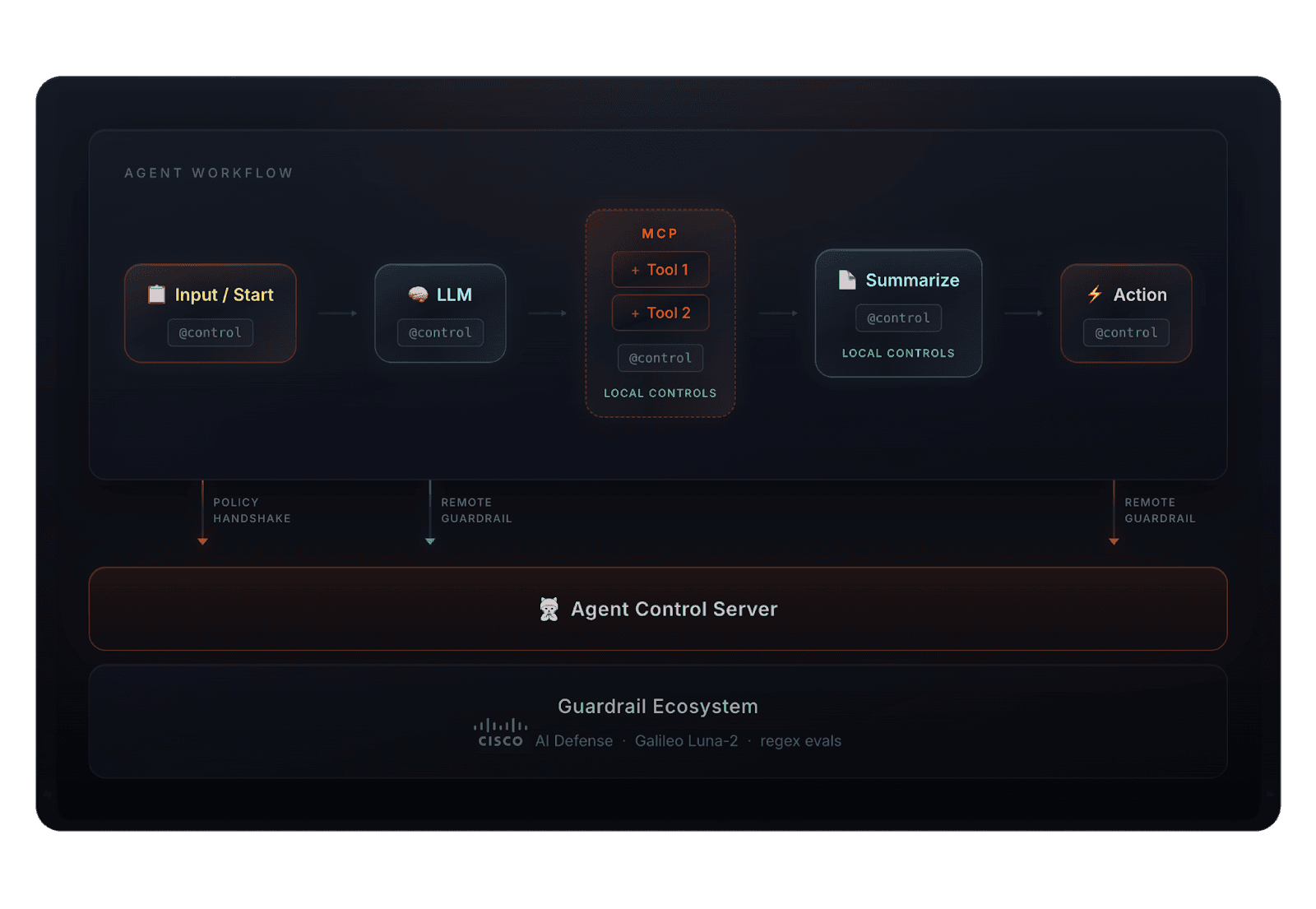
Agent Control introduces a Centralized Control Plane for AI Agents. It provides an API-first approach for developers to define runtime policies that can block, modify, or steer agent behavior based on organizational policies in real time, without modifying agent code.
Through this partnership, Cisco AI Defense provides security guardrail evaluators that integrate directly into the Agent Control framework. This allows developers to leverage Cisco’s AI Defense enterprise product to add robust runtime protection to their agents via the open-source Agent Control server.
With this integration, developers get access to Cisco AI Defense’s runtime guardrails at their fingertips and enterprises can manage / enforce a consistent set of guardrails across all of their AI Agents in production.
How it Works: The @control Decorator
Governing an agent is now as simple as adding a single line of code. Developers can apply the @control decorator to LLM calls or tool invocations:
@control("tool_selection")

async def llm_call(message: str) -> str:

    # Cisco AI Defense evaluates the intent and plan before execution

    return await llm.generate(message)
Before the LLM executes a tool call, the request is evaluated against runtime guardrails. The same capability is available via the TypeScript SDK, enabling integration across modern agent frameworks.
With Cisco AI Defense integrated as an evaluator within Agent Control, enterprises can:
Secure Agents: Inspect all agent and tool interactions before execution.
Prevent Data Leakage: Ensure agents don't inadvertently leak PII or sensitive data.
Enforce Enterprise Compliance: Apply real-time modifications to control unwanted behavior without taking agents offline.
# Control Definition that uses "cisco.ai_defense" evaluator

{
  "description": "Block unsafe model outputs via Cisco AI Defense",
  "enabled": true,
  "execution": "server",
  "scope": { "step_types": ["llm"], "stages": ["post"] },
  "selector": { "path": "output" },
  "evaluator": {
    "name": "cisco.ai_defense",
    "config": {
      "api_key_env": "AI_DEFENSE_API_KEY",
      "region": "us",
      "timeout_ms": 15000,
      "on_error": "allow",
      "messages_strategy": "single",
      "payload_field": "output"
    }
  },
  "action": { "decision": "deny" },
  "tags": ["ai_defense", "safety"]
}
Why This Matters for the Enterprise
For organizations with thousands of employees, "bespoke" security doesn't scale. This partnership offers four key benefits:
Centralized Policy Enforcement: Define Cisco AI Defense security policy in the Agent Control Plane once and enforce it across all agents and tools.
Open Standard: As an open standard (Apache 2.0 License), Agent Control ensures your governance framework remains flexible as your AI stack evolves.
Real-Time Mitigation: Use the Agent Control Dashboard to monitor pass rates and activity across all deployed agents, making updates on the fly.
Cross-Team Governance: Security, compliance, and engineering teams can collaboratively manage policies.
Looking Ahead
With the launch of Agent Control, developers now have an open, extensible framework for governing agent behavior at runtime. By integrating Cisco AI Defense guardrails into the Agent Control ecosystem, enterprises can deploy autonomous agents with confidence, visibility and control.
Visit agentcontrol.dev and Cisco AI Defense to learn more. Follow the launch on social and join the Slack community to collaborate with the growing Agent Control ecosystem.
Ready to bring order to your agent workflows?
The era of AI agents is rapidly moving from experimentation to production. Enterprises are beginning to deploy agents that plan actions, call tools, and automate workflows across systems. This shift introduces a critical challenge: How do you control and secure agents that can autonomously execute actions?
Today, Cisco AI Defense is partnering with Galileo, as a launch partner for Agent Control, a new open standard designed to govern the runtime behavior of AI agents. Through this partnership, Cisco brings enterprise-grade runtime guardrails into the Agent Control ecosystem.
Galileo, an AI observability company that helps enterprises ship trustworthy AI agents, have contributed Agent Control as an open-source offering with Apache 2.0 license to enable enterprises to develop a centralized governance stack for their AI agents in production.
By integrating Cisco’s industry-leading AI Defense guardrails directly into the Agent Control ecosystem, we are giving developers the tools they need to deploy agents with unprecedented trust, security, and centralized governance.
The Challenge: No Centralized Control Plane for AI Agents
Until now, controlling agent behavior has been a fragmented, manual process. Developers often relied on:
Hard-coded guardrails embedded directly in the agent code.
Bespoke, decentralized logic that is brittle and implemented differently across each agent.
High-latency evaluations that slow down the very automation agents are meant to provide.
This "hard-coded" approach means there is no centralized control plane to monitor, audit and enforce agent behavior in real-time. If a policy needs to change, engineers have to re-deploy the entire agent.
The Solution: Agent Control + Cisco AI Defense
Agent Control introduces a Centralized Control Plane for AI Agents. It provides an API-first approach for developers to define runtime policies that can block, modify, or steer agent behavior based on organizational policies in real time, without modifying agent code.
Through this partnership, Cisco AI Defense provides security guardrail evaluators that integrate directly into the Agent Control framework. This allows developers to leverage Cisco’s AI Defense enterprise product to add robust runtime protection to their agents via the open-source Agent Control server.
With this integration, developers get access to Cisco AI Defense’s runtime guardrails at their fingertips and enterprises can manage / enforce a consistent set of guardrails across all of their AI Agents in production.
How it Works: The @control Decorator
Governing an agent is now as simple as adding a single line of code. Developers can apply the @control decorator to LLM calls or tool invocations:
@control("tool_selection")

async def llm_call(message: str) -> str:

    # Cisco AI Defense evaluates the intent and plan before execution

    return await llm.generate(message)
Before the LLM executes a tool call, the request is evaluated against runtime guardrails. The same capability is available via the TypeScript SDK, enabling integration across modern agent frameworks.
With Cisco AI Defense integrated as an evaluator within Agent Control, enterprises can:
Secure Agents: Inspect all agent and tool interactions before execution.
Prevent Data Leakage: Ensure agents don't inadvertently leak PII or sensitive data.
Enforce Enterprise Compliance: Apply real-time modifications to control unwanted behavior without taking agents offline.
# Control Definition that uses "cisco.ai_defense" evaluator

{
  "description": "Block unsafe model outputs via Cisco AI Defense",
  "enabled": true,
  "execution": "server",
  "scope": { "step_types": ["llm"], "stages": ["post"] },
  "selector": { "path": "output" },
  "evaluator": {
    "name": "cisco.ai_defense",
    "config": {
      "api_key_env": "AI_DEFENSE_API_KEY",
      "region": "us",
      "timeout_ms": 15000,
      "on_error": "allow",
      "messages_strategy": "single",
      "payload_field": "output"
    }
  },
  "action": { "decision": "deny" },
  "tags": ["ai_defense", "safety"]
}
Why This Matters for the Enterprise
For organizations with thousands of employees, "bespoke" security doesn't scale. This partnership offers four key benefits:
Centralized Policy Enforcement: Define Cisco AI Defense security policy in the Agent Control Plane once and enforce it across all agents and tools.
Open Standard: As an open standard (Apache 2.0 License), Agent Control ensures your governance framework remains flexible as your AI stack evolves.
Real-Time Mitigation: Use the Agent Control Dashboard to monitor pass rates and activity across all deployed agents, making updates on the fly.
Cross-Team Governance: Security, compliance, and engineering teams can collaboratively manage policies.
Looking Ahead
With the launch of Agent Control, developers now have an open, extensible framework for governing agent behavior at runtime. By integrating Cisco AI Defense guardrails into the Agent Control ecosystem, enterprises can deploy autonomous agents with confidence, visibility and control.
Visit agentcontrol.dev and Cisco AI Defense to learn more. Follow the launch on social and join the Slack community to collaborate with the growing Agent Control ecosystem.
Ready to bring order to your agent workflows?
The era of AI agents is rapidly moving from experimentation to production. Enterprises are beginning to deploy agents that plan actions, call tools, and automate workflows across systems. This shift introduces a critical challenge: How do you control and secure agents that can autonomously execute actions?
Today, Cisco AI Defense is partnering with Galileo, as a launch partner for Agent Control, a new open standard designed to govern the runtime behavior of AI agents. Through this partnership, Cisco brings enterprise-grade runtime guardrails into the Agent Control ecosystem.
Galileo, an AI observability company that helps enterprises ship trustworthy AI agents, have contributed Agent Control as an open-source offering with Apache 2.0 license to enable enterprises to develop a centralized governance stack for their AI agents in production.
By integrating Cisco’s industry-leading AI Defense guardrails directly into the Agent Control ecosystem, we are giving developers the tools they need to deploy agents with unprecedented trust, security, and centralized governance.
The Challenge: No Centralized Control Plane for AI Agents
Until now, controlling agent behavior has been a fragmented, manual process. Developers often relied on:
Hard-coded guardrails embedded directly in the agent code.
Bespoke, decentralized logic that is brittle and implemented differently across each agent.
High-latency evaluations that slow down the very automation agents are meant to provide.
This "hard-coded" approach means there is no centralized control plane to monitor, audit and enforce agent behavior in real-time. If a policy needs to change, engineers have to re-deploy the entire agent.
The Solution: Agent Control + Cisco AI Defense
Agent Control introduces a Centralized Control Plane for AI Agents. It provides an API-first approach for developers to define runtime policies that can block, modify, or steer agent behavior based on organizational policies in real time, without modifying agent code.
Through this partnership, Cisco AI Defense provides security guardrail evaluators that integrate directly into the Agent Control framework. This allows developers to leverage Cisco’s AI Defense enterprise product to add robust runtime protection to their agents via the open-source Agent Control server.
With this integration, developers get access to Cisco AI Defense’s runtime guardrails at their fingertips and enterprises can manage / enforce a consistent set of guardrails across all of their AI Agents in production.
How it Works: The @control Decorator
Governing an agent is now as simple as adding a single line of code. Developers can apply the @control decorator to LLM calls or tool invocations:
@control("tool_selection")

async def llm_call(message: str) -> str:

    # Cisco AI Defense evaluates the intent and plan before execution

    return await llm.generate(message)
Before the LLM executes a tool call, the request is evaluated against runtime guardrails. The same capability is available via the TypeScript SDK, enabling integration across modern agent frameworks.
With Cisco AI Defense integrated as an evaluator within Agent Control, enterprises can:
Secure Agents: Inspect all agent and tool interactions before execution.
Prevent Data Leakage: Ensure agents don't inadvertently leak PII or sensitive data.
Enforce Enterprise Compliance: Apply real-time modifications to control unwanted behavior without taking agents offline.
# Control Definition that uses "cisco.ai_defense" evaluator

{
  "description": "Block unsafe model outputs via Cisco AI Defense",
  "enabled": true,
  "execution": "server",
  "scope": { "step_types": ["llm"], "stages": ["post"] },
  "selector": { "path": "output" },
  "evaluator": {
    "name": "cisco.ai_defense",
    "config": {
      "api_key_env": "AI_DEFENSE_API_KEY",
      "region": "us",
      "timeout_ms": 15000,
      "on_error": "allow",
      "messages_strategy": "single",
      "payload_field": "output"
    }
  },
  "action": { "decision": "deny" },
  "tags": ["ai_defense", "safety"]
}
Why This Matters for the Enterprise
For organizations with thousands of employees, "bespoke" security doesn't scale. This partnership offers four key benefits:
Centralized Policy Enforcement: Define Cisco AI Defense security policy in the Agent Control Plane once and enforce it across all agents and tools.
Open Standard: As an open standard (Apache 2.0 License), Agent Control ensures your governance framework remains flexible as your AI stack evolves.
Real-Time Mitigation: Use the Agent Control Dashboard to monitor pass rates and activity across all deployed agents, making updates on the fly.
Cross-Team Governance: Security, compliance, and engineering teams can collaboratively manage policies.
Looking Ahead
With the launch of Agent Control, developers now have an open, extensible framework for governing agent behavior at runtime. By integrating Cisco AI Defense guardrails into the Agent Control ecosystem, enterprises can deploy autonomous agents with confidence, visibility and control.
Visit agentcontrol.dev and Cisco AI Defense to learn more. Follow the launch on social and join the Slack community to collaborate with the growing Agent Control ecosystem.
Ready to bring order to your agent workflows?
The era of AI agents is rapidly moving from experimentation to production. Enterprises are beginning to deploy agents that plan actions, call tools, and automate workflows across systems. This shift introduces a critical challenge: How do you control and secure agents that can autonomously execute actions?
Today, Cisco AI Defense is partnering with Galileo, as a launch partner for Agent Control, a new open standard designed to govern the runtime behavior of AI agents. Through this partnership, Cisco brings enterprise-grade runtime guardrails into the Agent Control ecosystem.
Galileo, an AI observability company that helps enterprises ship trustworthy AI agents, have contributed Agent Control as an open-source offering with Apache 2.0 license to enable enterprises to develop a centralized governance stack for their AI agents in production.
By integrating Cisco’s industry-leading AI Defense guardrails directly into the Agent Control ecosystem, we are giving developers the tools they need to deploy agents with unprecedented trust, security, and centralized governance.
The Challenge: No Centralized Control Plane for AI Agents
Until now, controlling agent behavior has been a fragmented, manual process. Developers often relied on:
Hard-coded guardrails embedded directly in the agent code.
Bespoke, decentralized logic that is brittle and implemented differently across each agent.
High-latency evaluations that slow down the very automation agents are meant to provide.
This "hard-coded" approach means there is no centralized control plane to monitor, audit and enforce agent behavior in real-time. If a policy needs to change, engineers have to re-deploy the entire agent.
The Solution: Agent Control + Cisco AI Defense
Agent Control introduces a Centralized Control Plane for AI Agents. It provides an API-first approach for developers to define runtime policies that can block, modify, or steer agent behavior based on organizational policies in real time, without modifying agent code.
Through this partnership, Cisco AI Defense provides security guardrail evaluators that integrate directly into the Agent Control framework. This allows developers to leverage Cisco’s AI Defense enterprise product to add robust runtime protection to their agents via the open-source Agent Control server.
With this integration, developers get access to Cisco AI Defense’s runtime guardrails at their fingertips and enterprises can manage / enforce a consistent set of guardrails across all of their AI Agents in production.
How it Works: The @control Decorator
Governing an agent is now as simple as adding a single line of code. Developers can apply the @control decorator to LLM calls or tool invocations:
@control("tool_selection")

async def llm_call(message: str) -> str:

    # Cisco AI Defense evaluates the intent and plan before execution

    return await llm.generate(message)
Before the LLM executes a tool call, the request is evaluated against runtime guardrails. The same capability is available via the TypeScript SDK, enabling integration across modern agent frameworks.
With Cisco AI Defense integrated as an evaluator within Agent Control, enterprises can:
Secure Agents: Inspect all agent and tool interactions before execution.
Prevent Data Leakage: Ensure agents don't inadvertently leak PII or sensitive data.
Enforce Enterprise Compliance: Apply real-time modifications to control unwanted behavior without taking agents offline.
# Control Definition that uses "cisco.ai_defense" evaluator

{
  "description": "Block unsafe model outputs via Cisco AI Defense",
  "enabled": true,
  "execution": "server",
  "scope": { "step_types": ["llm"], "stages": ["post"] },
  "selector": { "path": "output" },
  "evaluator": {
    "name": "cisco.ai_defense",
    "config": {
      "api_key_env": "AI_DEFENSE_API_KEY",
      "region": "us",
      "timeout_ms": 15000,
      "on_error": "allow",
      "messages_strategy": "single",
      "payload_field": "output"
    }
  },
  "action": { "decision": "deny" },
  "tags": ["ai_defense", "safety"]
}
Why This Matters for the Enterprise
For organizations with thousands of employees, "bespoke" security doesn't scale. This partnership offers four key benefits:
Centralized Policy Enforcement: Define Cisco AI Defense security policy in the Agent Control Plane once and enforce it across all agents and tools.
Open Standard: As an open standard (Apache 2.0 License), Agent Control ensures your governance framework remains flexible as your AI stack evolves.
Real-Time Mitigation: Use the Agent Control Dashboard to monitor pass rates and activity across all deployed agents, making updates on the fly.
Cross-Team Governance: Security, compliance, and engineering teams can collaboratively manage policies.
Looking Ahead
With the launch of Agent Control, developers now have an open, extensible framework for governing agent behavior at runtime. By integrating Cisco AI Defense guardrails into the Agent Control ecosystem, enterprises can deploy autonomous agents with confidence, visibility and control.
Visit agentcontrol.dev and Cisco AI Defense to learn more. Follow the launch on social and join the Slack community to collaborate with the growing Agent Control ecosystem.
Ready to bring order to your agent workflows?

Yash Sheth